If any of the following sound familiar, you will be delighted to know you can eliminate them all!
- Feeling like an outsider
- Never feeling like you are good enough
- Being aware of an inner emotional heaviness or depression
- Experiencing a repetitive pattern of disappointment
- The emotional heat of perpetual anger
- The inability to deeply connect with other people
- Blaming and judging yourself and others when things don’t go “your way.”
Each and every one of these is the direct result of specific beliefs, fears, or misconceptions through which you are filtering new experiences in your Reticular Activating System.
The Reticular Activating System (RAS) is truly a marvel of human design. Here’s what it does:
- regulates our sleep-wake transitions
- coordinates and integrates our cardiovascular, respiratory, and motor response to external stimuli
- controls our coordination
- processes the vast majority of our incoming sensory information
Do you have any idea how much new information your brain is constantly processing? In his book, Strangers to Ourselves, Timothy Wilson quantifies the human brain’s unfathomable ability to process information as follows:
The unconscious processing abilities of the human brain are estimated at approximately 11 million pieces of information per second. Compare that to the estimate for conscious processing: about 40 pieces per second.
Without our RAS, this barrage would quite literally blow our minds! We live in a constant state of data bombardment.
The fact that the vast majority of our data processing is unconscious is a great kindness in human design. However, this unconscious filtration system runs on autopilot while determining what incoming information we value, devalue, or fear based on our accumulated past reactions.
Like the default settings on our computers, our past data processing decisions function as self-fulfilling prophecies of our present and future data filtration, unless and until we bring them to awareness for reevaluation.
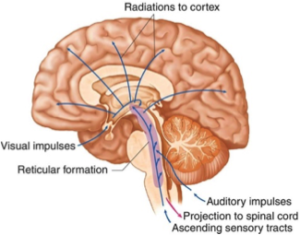
Mosby’s Medical Dictionary, 9th edition © 2009, Elsevier
The RAS is located in the brainstem. It consists of a network of nerve pathways. They form a link between the brain stem, which controls most of the body’s involuntary functions and reflexes, and the cerebral cortex, which is the seat of consciousness and our thinking ability. By connecting these two regions of the brain, the RAS functions as a filtering system for the mind. It controls our attention, awareness, thinking, and emotions. It quite literally causes us to construct our own internal worldview.
While we share our physical world, we each have our very own unique inner world. What we are seeing is not as it is in the physical world. We see the world as it is after being processed through our inner filters. Our sense of truth is relative to our inner filtration system.
The good news is you have the power to change the settings on your filtration system. Through increased awareness of how this system works and by paying attention to all forms of imbalance you experience, you have the power to change your inner and outer experiences.
We are biased to the status quo of how we already see things.
Believing that this internally-generated version of the truth is the empirical truth blinds us from reality.
One of the consequences of this misconception is that we believe that anyone whose perspective or way of being is different than ours is “wrong.” What we imagine to be our perception of empirical truth is merely a reflection of an aggregated inner point of view.
Within the privacy of our own consciousness – in the theater of our mind – we create our own sense of reality, which we inhabit and relate to as if it is REALITY.
It is important to remember that no one else on this planet has an identical inner world to the one you live in. The assumption that others see the world as we do is the source of an enormous amount of our misunderstanding about ourselves and each other.
The majority of our perceptions and thoughts are merely the product of our primarily unconscious sensory data filtration system. They exist only in our private inner world.
Understanding the design of the data processing function of the RAS empowers us to do some renovations to the mental and emotional scaffolding upon which we are living our lives.
We access this opportunity by paying attention to where things are not working well for us in our lives. To bring our autopilot ways of responding to our experiences into conscious awareness, we need to identify what is on our filter. So, take a good look at your underlying conditioning, beliefs, assumptions, expectations, prejudices, preferences, fears, memories, judgments, illusions, delusions, hopes, and dreams. Only then, do we have the option to challenge our default settings and change them as appropriate.
Another way of saying this is we need to clean our data processing filters. In doing so, we can update our default settings. Our freedom lies in recognizing that our RAS makes our lives a self-fulfilling prophecy. It is simply doing what we tell it to do. When we update our default settings, we are redirecting the perspective of our RAS so that it will now validate our new point of view.
Consider this simple example. While on a weight loss journey, I got to within one pound of what I viewed as a major threshold. I plateaud there for six weeks. I was doing everything “right” in terms of complying with my program. What was going on? Upon evaluation of my RAS filters, I noticed that I held a belief that crossing this particular one-pound threshold would put me into a level of success that I had not previously experienced.
Underneath that I discovered that I was fearful and did not trust myself to maintain this success. In this context, my weight loss plateau made perfect sense. Once I identified the source of resistance to further progress, I was able to bring more of this pattern into conscious awareness and to challenge myself to see my situation through new eyes.
When we get stuck, we need to look to see exactly what beliefs and fears have been preventing us from moving forward. Then, we can choose to replace them with new, affirming beliefs and assumptions.
Bringing unconscious patterns into awareness empowers us to upgrade our default settings in such a way that upgrades the quality of our inner life.

![]()
If you would like to know more about me and my work, please explore my website here.
Do you know someone who might benefit from reading this article?If so, please share it with them.
The Power of Questions: Why Curiosity Changes Everything
So often, we are looking for answers, solutions, fixes, and explanations to alleviate our discomfort. But what if the real transformation begins not with the answers we find, but with the questions we ask?
Whether we’re trying to understand ourselves, navigate a challenging relationship, or make sense of the world, the way we frame our questions determines the path our thoughts will follow. Each question opens a door and closes others. This is the quiet power of inquiry.
The Hidden Force Behind Thought
Our minds are constantly in motion. Thoughts come and go, many driven by unconscious questions we don’t even realize we’re asking.
Questions like:
“What’s wrong with me?”
“Why is this happening to me?”
“Will they ever change?”
Without realizing it, we often narrow our focus through these kinds of inquiries. They carry assumptions, they trigger old patterns, and they limit what we’re able to see.
But there’s another way.
When we bring our questions into conscious awareness, we can begin to shape the direction of our attention with intention. We can shift from judgment to curiosity, from blame to understanding, and from limitation to possibility.
Asking Better Questions of Ourselves
Self-inquiry is one of the most powerful tools we have for healing, growth, and clarity. Try asking simple, gentle questions like:
“What am I feeling right now?”
“What do I need in this moment?”
“What is this really about for me?”
Questions like this invite us inward. They create space for reflection, self-compassion, and a deeper understanding of our emotions. They help us respond with care instead of reacting with confusion or fear.
What Happens When We Ask with Curiosity
In my work with couples, I’ve seen how dramatically the tone of a conversation can change when we shift from defensive statements to open questions.
Instead of:
Instead of:
Open-ended questions are invitations. They say: I want to know you. I care about what’s real for you. And in that space, trust can grow.
Questions That Build Connection
Here are a few questions that can gently deepen connection and emotional safety in any relationship:
What matters most to you in this situation?
How can I support you right now?
What are we both not seeing yet?
What do you need from me in this moment?
Is there another way we could look at this?
The goal is not to “get it right,” but to stay curious. When we lead with curiosity, we soften the ground between us and invite discovery instead of defensiveness.
The Soul of a Question
A question is more than words. It carries intention.
Is your question meant to control or to understand?
Is it rooted in fear, or in a genuine desire to connect?
Is it trying to prove a point, or open a door?
When asked with presence and care, a question becomes a mirror, a flashlight, a bridge.
It is a sacred tool. One that can gently illuminate what was hidden, and return us to what matters most.
Reflection Prompt:
If you would like to know more about me and my work, please explore my website here.
Consciousness Ecology: Inner Clarity In a Noisy World
What Is Consciousness Ecology?
Consciousness Ecology is the art and practice of tending to your inner environment. Just as an ecosystem depends on balance, so too does your state of mind and heart. This practice invites us to look inward and examine the beliefs, stories, habits, and emotional patterns that silently shape how we see the world and navigate our lives.
As Plotinus wisely said, “Withdraw into yourself and look.” Consciousness Ecology is this very invitation—to return inward and tend to the landscape within.
Why It Matters
Many of us carry internal “clutter” from unresolved experiences, outdated beliefs, and unconscious fears. These internal dynamics distort how we interpret situations, how we treat others, and how we treat ourselves. Over time, we may find ourselves reacting to life rather than engaging with it consciously.
We are not victims of our conditioning unless we choose to be. Consciousness Ecology offers us a pathway out of unconscious living and into empowered awareness.
5 Core Practices of Consciousness Ecology
Releasing Unresolved Perceptions
Let go of emotional residue from the past that clouds your ability to be present.
Reframing Your Perspective
Learn to reinterpret events through a more compassionate, expansive lens.
Redefining Inner Values
Reassess what you value and fear and update the filters that shape your worldview.
Practicing Healthier Ways of Being
Integrate new thought and behavior patterns that support emotional well-being.
Exploring Expanded States of Consciousness
Open to the higher frequencies of awareness that are available to all of us.
The Role of Your Attitude Filter
Think of your mind as equipped with an “Attitude Filter” that functions as a gateway that processes everything you see, hear, and experience. This filter is shaped by family conditioning, cultural messages, past wounds, and personal conclusions. If it becomes too clouded, it distorts your view of reality.
By conducting regular mental and emotional audits such as journaling, self-reflection, or using guided questions you begin to “clean the filter.” Over time, your perception becomes clearer, your reactions more grounded, and your choices more aligned.
A Gentle Audit for Greater Awareness
When you feel stuck, reactive, or off-center, pause and explore:
What am I believing in this moment?
Is that belief absolutely true?
What feeling or past experience might be fueling this reaction?
What might I choose to believe or feel instead?
Awareness, curiosity, and self-compassion are your allies in this process.
From Reaction to Reintegration
Much of our inner struggle stems from exiled parts of ourselves. We may have pushed away shame, fear, anger, or grief because we didn’t have the tools to face them. Through Consciousness Ecology, we return to these parts with kindness, and welcome them home.
As spiritual teacher Robert Waterman describes, healing comes through reintegration. We remember who we are, not in fragments, but as a whole being capable of healing, clarity, and peace.
Making Consciousness Ecology a Way of Life
Like brushing your teeth or nourishing your body, Consciousness Ecology is a form of hygiene for the mind and heart. It doesn’t eliminate life’s challenges, but it prepares you to meet them with resilience and presence.
You might begin by:
Starting a weekly self-reflection journal
Holding regular emotional “check-ins” with a partner or trusted friend
Noticing and shifting negative self-talk in real time
Asking: What energy am I bringing to this moment?
The more consistently you practice, the more you will experience clarity, peace, and personal power.
The Invitation
You don’t need to wait for a crisis to begin. You can start today. Look within. Ask the questions. Listen to your inner world. Reclaim your clarity and wholeness.
If you would like to know more about me and my work, please explore my website here.
When Your Dreams Don’t Come True
How often are you disappointed? Do your disappointments tend to be about life-altering things or just not getting what you want in daily life? Just because we want something doesn’t mean it will or should show up in our life.
Acceptance is the key here because it allows you to move on to figuring out what to do next rather than being upset about what didn’t happen.
A 12-year-old contestant on America’s Got Talent taught me a powerful lesson about this recently. While singing her heart out, she was interrupted when Simon Cowell stopped the music. He told her the background track was awful and would she please sing her song a cappella. She looked like a deer in the headlights and after a moment simply said, “Well, that just happened!” She regained her composure and sang beautifully.
There is a fundamental dynamic that occurs when we encounter disappointment. As depicted below, Point A is where you are and Point B is your unfulfilled dream.
When reality falls short of your desires, do you accept that? Or, does your mind create a static of negative thoughts and feelings as it tries to connect the dots. When we are attached to our desires, we get caught in the dissonance of trying to bridge the gap between where we are and where we want to be.
Alternatively, like the girl mentioned above, we can acknowledge where we are, gather our composure and capabilities, and do our best in the moment. This way we don’t postpone and limit our potential happiness by being attached to a particular dream coming true. Maybe there is a better dream trying to come forward.
No matter how much you want your dream, holding onto it too tightly diminishes your ability to do your best with what is so for you in the present moment. Here’s a typical example. Cynthia is in her early thirties and has always wanted to get married and have children. She is aware of her biological clock ticking away and is distressed that she hasn’t yet found a partner. She believes she has done everything “right” to make her dream come true, yet she remains alone and sees her chance to fulfill this dream slipping away.
Holding on too tightly to her dream has prevented her from appreciating the life she has. Some part of her believes she can only be really happy if her dream comes true. The flaw in her approach is that she is preventing herself from finding happiness in her actual life.
A perpetual state of disappointment can easily lead to depression and despair. I’ve had clients who were so devastated by their unfulfilled dreams that they numbed themselves from feeling their despair. Some got caught in substance addictions. Others distracted themselves with unrealistic To-Do Lists and saying “Yes” to whatever anyone else wanted them to do, just to avoid feeling their accumulated misery.
It is critically important to be honest with yourself about how you feel. Doing so will bring you home to the present moment. I often suggest that clients throw themselves a pity party for 10 minutes or so and really wallow in their misery. Give voice to it and cry a river if you need to. Just do so with the intention of releasing the pent up and unexpressed disappointment. Then, get on with being where you are in your life and making delicious lemonade out whatever lemons you think life has dealt you.
One typical illulsion some of us get caught up in is the belief that our lives should be easier than they are. We often make an assumption that getting from here to there will be uneventful and easy. Chances are it won’t be. Life is full of twists and turns.
Take your life as it comes. Do your best. Let it be a great adventure. Keep your focus on the present. Respond to the reality of your life rather than trying to force your dreams to come true.
My spiritual teacher, John-Roger, taught me to express my hopes and dreams in a prayerful way that asks, “May this or something greater that is for my highest good come forward.” Then, let it go, and put one foot in front of the other, staying present in my life.
If you would like to know more about me and my work, please explore my website here.
Do You Feel Like You’re On The Outside Looking In?
One theme I have noticed with many of my mentoring clients is the feeling of being on the outside looking in. This might be how they feel in a particular social situation such as with their family, at work, or with a particular group of friends. For some, it is what they repeatedly experience. For many, this began during school days and has been with them throughout their lives.
It’s a pervasive experience of wanting to be on the inside, but standing alone watching others being connected to each other. Some believe they have been selectively and intentionally left out.
I remember feeling trapped in this position in high school. The “in crowd” seemed to really be having a fabulous time. I watched from the periphery wondering what was wrong with me that I didn’t authentically want to be doing what they were doing. And, why didn’t it matter to them whether I was part of the group or not?
I wanted the fun they were having, but I knew that I would have to fake it to be a part of the group. I wasn’t good at that.
Feelings of not fitting in, not being chosen, and just not belonging anywhere dominated my experiences in high school.
As life marched on, I noticed myself experiencing this outsider phenomenon repeatedly. It was my norm in social situations until I started to take a good look at it. I noticed a few important things that became my opportunity to break free. And, eventually I began to help others to do so as well. Here are some keys to moving away from the experience of being the outsider looking in:
Observe your experience, but don’t make it wrong.
It’s easy to fall into the false assumption that because they are having fun and you aren’t that “they are right and therefore you are wrong.” That’s a dead end proclamation. It robs you of the opportunity to consider other possibilities. That’s why observation rather than judgment is so important.
Our negative feelings are feedback to us of being out of balance inside. They are not cause for judgment of ourselves or others. Observation leads to neutral conclusions that allow us to explore our options.
Neutral observations might look like “I want to have fun. Standing here watching them is not fun for me. What else might I do to have the experience I am looking for? What is fun for me? What would be more fun for me than standing here watching them have fun?”
It stands to reason that if you put your hand over a burning flame, it hurts and the healthy response is to move your hand away and learn not to do that again. So, apply that logic here.
Look Inward, Not Outward.
When you find yourself distressed watching others seemingly having a good time, notice that you are doing that. You are creating that perception and reaction inside of you. Choose to look at that inner process of creation rather than outward at what others are doing.
Work with the information in a healthier way by using it to explore the resonance within you that your feelings are tapping into. Is this current experience tapping into some unresolved hurt from the past? If so, take a look at that and see if you can make peace with it. Seek understanding and healing of any past disturbances so you can be free and healthy in encountering new experiences.
Consider the Possibility That You Are Creating a Self-Fulfilling Prophecy
If you keep having this same experience, consider the fact that it is a matter of faulty perception. When you repeatedly make yourself wrong each time you encounter the feeling of being disconnected from others, you simply pile on more bad feelings on top of old, unresolved feelings.
The pain gets bigger and bigger because each encounter touches into a mother load of unresolved feelings you carry around you. Convinced that you are “right” in your interpretation of being “wrong” (having never considered an alternative) makes your perspective a self-fulfilling prophecy.
Pay Attention to What Works for You and What Doesn’t
Keep paying attention to your inner experiences. Notice how you perceive and react to outer situations. Do you see patterns? Create more of what works for you. And, get to work on dismantling repetitive negative patterns of perception and behavior. That’s called mastering the art of living. It will bring you much more fulfillment, joy, and satisfaction. Lovingly attend to your own sense of imbalance.
Look Elsewhere.
Explore what other options are available to you. Stop wanting to be part of something that doesn’t make you happy. If the shoe doesn’t fit, try on a different shoe. Go for what fits, not for what you wish would fit, but doesn’t.
Go for the feeling and experience you are looking for, don’t demand the conditions under which those feelings will manifest. Be committed to finding your own form of happiness where you fit in and feel good about yourself. Don’t settle for anything less.
Live inside your own experience. Honor your own truth. Trust that you belong in this world just the way you are. Love yourself madly and deeply!
If you would like to know more about me and my work, please explore my website here.
The Top 5 Things to Do When a Loved One Is Dying
Like a soldier going into battle for the first time, being my mother’s caregiver for the final nine years of her life was a baptism by fire for me. My mother and I learned so much useful information through those years that she made me promise I would write a book about what we learned. I was so gratified when someone told me that Making Peace with Death and Dying it should be a reference book in every home. Here are the top five things I learned about dealing with death:
1. Don’t assume you are supposed to know what to do.
We live in a death-denying culture that has a hard time even saying the word “death.” We are not taught how to face our own death or that of a loved one. It is therefore no surprise that many of us panic in death’s presence. At the very least, it is common to be ill at ease. We don’t know what to do or not do.
So, remember it is normal to be ill-prepared to face death – your own or that of a loved one. Recognize this state of affairs. Don’t pressure yourself to “do it right.” When someone you love is dying, it’s okay to be a mess. Just try not to dump your mess on others — especially the one who is dying.
No two people are going to respond the same way to a death. Most will be woefully unprepared and unskilled at dealing with the situation. This will not, however, stop some from shirking their responsibility or being self-appointed bullies demanding that others follow their lead.
The best approach is to lead with your heart. Keep your love flowing with the dying person and others as well — if possible. Nothing is more important than loving each other. Do your best and then some.
2. Make it a priority to demonstrate your love for the person who is dying.
The fact that your loved one is dying can be overwhelming and scary. Do your best not to let that get in the way of keeping your love alive. You are there to see them off on their journey into the unknown territory of death. Love them up, down and sideways, but don’t make a big deal about it. Just let your love flow and watch for little things that you can do to be of service to them.
Accept the reality if a loved one is dying. Don’t try to deny it by saying things like, “Your color looks good today” when you both know he or she is dying. That’s like saying “I can’t handle this and need to pretend it isn’t happening.” Be honest. Be authentic. Be you. It’s okay to let them see your fear and distress, but don’t let that overshadow your love.
Express your gratitude to the dying person for the ways they enriched your life. Share happy memories and yes, do say goodbye — but do it tenderly. Don’t be afraid to touch the dying. Nothing communicates our love more than a loving touch. Hold their hand. Stroke their hair.
Tailor your efforts according to the time available. Respect the fact that time can be very short from hearing the prognosis to the actual time of death. One of my personal pet peeves is when people are inconvenienced by the news of a loved one’s impending death. They act as though their loved one should have checked on their availability rather than having the audacity to sound the red alert at an inopportune moment. When your mother has a 50/50 chance of making it through the night, you don’t show up four days later!
3. Respect the authority of the dying to make his or her own decisions.
The person who is dying is the boss. If they are conscious enough to be making their own decisions — don’t bully them into doing things your way. Just as sure as you are that your way is right for you, know that their way is right for them no matter how different it is from your own. If someone holding a healthcare proxy is in charge, respect his or her authority.
Ideally, each of us gets our ducks in a row before our dying time. In reality, most do not. As a result, a lot of financial, legal, physical, mental, emotional and spiritual life-or-death decisions get made in a hurry, at the last minute. This can cause a lot of chaos, confusion, conflict and mixed up emotions among family and loved ones. Do your best to quickly align yourself with the wishes of the dying. It is their death, not yours.
4. Accept that he or she is dying. Don’t fight against it.
It’s fine to hope that things will turn around and death will be postponed. However, if death is what is happening, it helps enormously to accept that fact. We are taught to fight against death like it is an evil monster. In fact, death is as normal as birth — we just haven’t been trained to see it that way. I find it sad when doctors and loved ones subject the dying to endless invasive drugs, tests and procedures when it is obvious that it is time to die. I am an enthusiastic supporter of hospice care for the dying.
Each of us is born one moment of one day, we die one moment of another day and have an unknown number of days to live in between.
5. Contribute to maintaining a peaceful environment.
When someone is dying, they have enough to do handling their own process. They might be dealing with physical pain, fear, emotional turmoil, confusion, regrets, etc. Assume that any discord in their environment will add to their load and be unkind on the part of those causing it.
If family members are squabbling, take it outside of the room. Consider the dying room a sacred space where only love and comforting activities are allowed unless the dying person requests otherwise.
If you would like to know more about me and my work, please explore my website here.
Are You Suffering Unnecessarily?
“Necessary suffering” seems like a strange concept to most people. But, consider the fact that no one gets to escape some form of pain in response to the trials and tribulations of life.
A certain amount of suffering comes with the territory of being alive. If we are lucky, we learn to use these experiences as steppingstones to greater wisdom and understanding. They also have a way of getting us to draw closer to one another. We instinctively comfort one another in ways that are deeper and less common than we find in everyday life.
The unnecessary kind of suffering, according to psycho-spiritual teacher, Robert Augustus Masters, is a direct result of the stories we tell ourselves about our painful experiences. Some people obsess about their suffering. Their tales of woe become a constant irritant, like a stone in your shoe that you don’t realize you can remove.
Portia was a client of mine. I don’t think she ever made it through a session without needing to recite the litany of trials and tribulations she had faced in her life. Suffering had become her central identity. She didn’t know herself without her suffering. She kept it alive in the present by talking about it all the time like a broken record. When I attempted to show her what she was doing and invited her into the process of releasing her attachment to suffering, she left. She interpreted that as my not being supportive enough of her.
Ironically, we minimize our suffering by facing it, entering into the pain that comes our way, and moving through it.
A great example of necessary and unnecessary pain can be seen in the contrast between two ways a woman might experience giving birth. One woman actively works with her breath to move through the pain of her labor. Another is busy resisting her pain and screaming about how much it hurts.
Ironically, we create unnecessary pain by the very act of resisting pain. In other words, through resistance, we focus upon our pain, draw it to ourselves, and attach ourselves to it.
Our point of view – our attitude toward suffering makes all the difference in terms of how much we suffer.
So, next time you start throwing a pity party for yourself, change your point of view so you can change your experience. Try one of these methods:
1. Expand your perspective to entertain the good news that is coming with the bad. In other words, appreciate the half full part of the glass you are only seeing as half empty. My friend, Barbara Sarah, founded the Oncology Support Program at HealthAlliance of the Hudson Valley in Kingston, NY. She shared with me a list that one of her students in a Constructive Living program made. It was a growing list identifying all the people who she was grateful to for helping her care for her hospitalized husband. 105 people and counting! As the list grew, so did her gratitude to these people. The list included such people as:
When we are encountering life’s challenges, it is important to acknowledge that our glass is not only half empty. It is simultaneously half full. So make a list of all the things in your life that are also true blessings while you are suffering. See if you don’t find yourself becoming so grateful that you forget a bit about your pain. This is about finding and restoring balance inside yourself.
2. Give yourself a deadline to finish your pity party. Give yourself 5-10 minutes or three hours to really get into all your complaints and suffering. Exaggerate the immensity of your pain and feel really sorry for yourself until the timer goes off. Then, choose to shift your focus onto doing something really thoughtful or supportive for yourself or someone else. Don’t allow yourself to start grabbing onto your pain again. If it hurts, breathe into it and keep going. Ask yourself, “Is there anything constructive I need to do about my pain?” If the answer is “yes” then do that, if it is “no” then make the choice to place your focus elsewhere.
3. Pray for your highest good. Prayer, in its highest form, is about trust and laying down your burdens. It is a surrendering to that which is beyond our comprehension. This kind of prayer is beyond personal preferences or judgments of what “should” or “shouldn’t” be happening. It acknowledges that there are forces present in our lives that are beyond our understanding. By praying for the highest good, we appeal to the benevolence of whatever forces are at work in our lives. We surrender our burdens to these forces. In other words, we acknowledge that what will happen is beyond our control. We accept that and go on about our business of living the best we can.
4. Decide to make fabulous lemonade out of your lemons. My spiritual teacher, John-Roger always advised using everything for our upliftment, learning, and growth. That advise has served me very well in the hardest of times. This is a matter of choice. We have the option of shifting the message we send ourselves about our suffering from “poor me, this is terrible” to “I wonder how I can work with this to lift myself up, to learn, and to grow.”
If you would like to know more about me and my work, please explore my website here.
What Do You Think Happens When We Die?
In the U.S., we have a culture of silence around dying and death. It’s a great taboo that fills most of us with anxiety about life’s end without any way to reduce that anxiety. We all know we are going to die, yet we don’t talk about it. The entire subject has become a mysterious and ominous kind of black hole in our consciousness, and we learn not to go there.
I think it would be really healthy for us to break through this taboo and normalize our conversation about death. It would free us to examine our beliefs, thoughts and feelings about death, both individually and collectively. Perhaps it would change how we feel about war and violence. By embracing the reality of death, we might be able to perceive a greater value and a deeper meaning of life.
Many people have never challenged what they were taught about death as children. This is not surprising in a society that doesn’t talk about death. Some of us question and affirm what we were first taught while others find it a starting point from which their beliefs evolve. I fall into this latter category.
When I began to explore the reality of death more deeply, I found that I was less afraid of death itself than I was of dying. I was anxious about not knowing when and how I would die. It terrified me when I thought of it. It was as though we all walk around with a huge question mark over our heads, not knowing how much time we have left. Here today, maybe gone tomorrow.
At first, I thought that God had a mean streak or a bad day when inventing death. I thought it was wrong and that we should live forever. But when I thought about that, I wondered what forever would be like — an endless story, a giant run-on sentence with no ending punctuation. Would there be no aging of the body or maturing of our minds in an endless now? Would we be stuck in a perpetual state of changeless being? The more I thought about the mixed blessings of being an infant, a child, a teen, a 20-year-old, a 40-year-old, and now a person in my 70s, the more I valued the exquisite design of this progression of maturation. I wouldn’t want to live endlessly in one frozen form without the punctuation of time passing. The more I thought this way, the more normal and appropriate death seemed.
When I delved further into the question of what happens when we die, I looked first at what I had been taught as a child. Just as many children learn to be good to get great presents from Santa, I was taught to be good in the way I lived my life so that I could earn eternal life with God. I had no idea what that meant other than that I shouldn’t be “bad.” It was a great inducement for conformity to the rules.
As I matured, my ideas about life, death, God and eternity evolved. I found myself to be eclectic in gathering bits and pieces of wisdom from around the world that resonated with a truth that existed inside of me. Where did that truth come from? I do not know. I just know that I have always recognized what is true for me by a process of reflection and inner resonance.
When I think about what happens to us when we die, I realize that I cannot address the matter without simultaneously looking at the purpose and meaning of life. Life and death seem to be woven together in an endless process of one birthing the other. I once wrote the following poem about this:
I believe that we are all souls having human experiences for the purpose of coming to know our divine nature in human form. We are coming into a oneness through and with God. In this context, what we commonly refer to as death is simply the death of this body and personality. It is the dropping of a human form by our real self — the soul. As far as I can tell, we really do see a bright light and loved ones on the other side of this death as we journey forward in our process of awakening. I believe that we do re-embody again and again as we strengthen our awareness of our own divinity. So, while I am saddened by the loss of connection to loved ones that occurs at death, I am comforted by my belief that this is one in a series of lives.
I know that many people do not share my particular beliefs. That is fine with me. Personally, I find it quite fascinating that “the truth” resonates differently in each of us.
If you would like to know more about me and my work, please explore my website here.
How to Maintain Your Inner Well-Being – Part 2
Did you know that your brain gives preference to visual information?
Researchers L.D. Rosenblum, Harold Stolovitch, and Erica Keeps refer to our senses as learning portals. They offer the following statistics regarding the percentage of data processed by each of our five senses:
Why is this significant?
Unaware that we are “seeing” the projection of an internally-filtered reality, we misinterpret our perceptions of reality to be reality itself. Consider the heated arguments between individuals of opposing political points of view. Each sees a different reality and believes that they are “right” and those on the other side of the aisle are “wrong.”
For most of us, our socialization includes indoctrination into a binary model of consciousness. In other words, we are taught to sort people and experiences into right/wrong, good/bad, beautiful/ugly, desirable/undesirable and so on. In fact, life is far more complex and messy than that.
Learned biases and preferences short-circuit the process of developing curiosity about those differences that we are taught to reject. There is a built-in bias against diversity in this way of encountering unfamiliar people and experiences. Therefore, diversity requires a new way of perceiving beyond our autopilot right/wrong sorting process.
By about the age of five or six, we have the foundation of our self-image in place and we begin to unconsciously protect, conceal, or improve our image of ourselves and to become competitive with the self-images of others. We spend most of our time focused outward through our self-image as we negotiate and navigate our way through the world and relate to the imagined self-images being projected by others.
We selectively see things that support our existing beliefs and filter out things that do not agree with our way of seeing things.
Another paradox of our visual orientation is that it makes it very difficult for us to verify and trust the existence of non-physical reality. This is the territory of self-knowledge, intuition, and spiritual awareness.
Paying attention to non-physical reality is a bit like being a salmon swimming upstream against the current. It requires an intentional redirection of our focus. To turn inward, we must engage in a more intimate relationship with ourselves. To awaken ourselves spiritually require a different state of mind.
Learning how to become more conscious of our own unique data sorting process is essential to mastering the art of being who we authentically are.
Spiritual awakening involves consciously and intentionally developing our ability to override our usual way of being and perceiving. It requires looking within rather than being drawn to an external focus by the dominance of visual sensory input we are receiving. It means cultivating a non-judgmental perspective towards differences and an awareness of a level upon which we are all the same.
This requires cultivation of a childlike curiosity rather than a defensive and competitive stance regarding our perceptions versus those of others. It requires an entirely different kind of awareness — not based on sensory data. Rather it is a matter of attunement to something greater than our physical form that is shared by all. Language and empirical science fail us in speaking clearly about such matters, but do not negate their existence.
Each of us has our own unique life to lead. As we learn about the power of the Reticular Activating System (RAS) it becomes clear that the quality of our consciousness determines how we experience our lives.
In case you missed it, here is the link to Part 1 of this blog post.
If you would like to know more about me and my work, please explore my website here.
How to Handle Family Dynamics Around a Dying Loved One
Families can be complicated, to say the least. When they are beautifully loving and caring, it’s one of God’s most delightful gifts. But often, when the well-being of a critically-ill loved one is involved, tensions can flare. We don’t all love in the same way. And, love is often tainted by self-serving motivations or competition for power and influence in decision-making.
In fact, terrible things can be done in the name of love. And, the dynamics of power and influence that can develop among family and loved ones can be shocking. Tensions can escalate as judgments and discord fester. Frequently, childhood politics surface and you suddenly find yourself the seven-year-old kid who used to be bullied by her older sister.
Everyone might sincerely believe they all have the patient’s best interest in mind. Yet, they may have diametrically opposed views about what that would look like and how it is to be accomplished. Unfortunately, all too often family members polarize against each other behind the scenes rather than uniting in support of the patient.
Here are some guidelines to help families navigate these stressful and emotionally challenging times.
Respect the patient’s right to make his or her own decisions as long as deemed mentally competent.
Recently, a client shared her family’s drama around their terminally-ill mother. Behind the scenes, some family members are under the impression that mother is depressed and needs antidepressants. They emailed her doctor urging him to prescribe them. Others are concerned about drug interactions and over-drugging mom. They worry about masking feelings that she needs the opportunity to process. When I asked what the mother wanted, my client didn’t know. No one had asked her. They were too busy campaigning for their point of view behind her back.
Be sure that the patient designates a healthcare proxy before being deemed mentally incompetent.
A client told me that her father was the healthcare proxy for her mother. However, he was terribly uncomfortable dealing with death and dying.
The choice of who to appoint should not be primarily governed by the person’s rank in the family pecking order. Rather, the patient should thoughtfully decide based upon who is most able to communicate comfortably with the patient about their needs and care. It should be someone ablle to advocate for the patient with doctors, nurses and caregivers. For example, a family member might hold a strong personal or religious belief that is quite different from that of the patient. This could prevent that individual from following the patient’s wishes. Therefore, they would not be a good choice to serve as healthcare proxy.
No matter how strong your opinion, that doesn’t make you an expert.
As a family member, you may have concerns about the treatment protocol and care being given to your loved one. Address it either with the patient and/or their healthcare proxy. Do not take it upon yourself to try to direct their care. Feel free to express your point of view, but respect the right of the person who is making the decisions. Be careful not to make others wrong for not agreeing with you.
Clarify, agree upon, and respect a pecking order for the flow of information and influence.
The role of the primary caregiver and/or healthcare proxy should be respected. They typically have the most up-to-date knowledge about the patient’s condition and needs. If you really want to demonstrate your love for the patient, than do everything you can to support this person. Offer your help. Be a team player. Help to keep communications clean and above board within the family.
Avoid the temptation to judge and talk about each other behind backs. If you have a problem, address it directly with the person(s) involved.
Having a loved one who is critically-ill is stressful enough. Do not make matters worse by bringing your personal animosity toward another family member into the situation.
Handle your emotional needs on your own. Don’t act them out around the patient.
It is important to be ruthlessly honest with yourself about how you feel and to deal with that within yourself. Be respectful of the patient’s needs and the normal routine that has been established for the patient’s care.
It is not uncommon for relatives who live at a distance to visit and try to overcompensate for their absence. They may be acting out of guilty feelings by playing the hero or trying to make a larger-than-life impact on the situation.
For example, don’t take it upon yourself to feed the patient two big bowls of oatmeal because that used to be his or her favorite breakfast. Find out what the patient is eating now and stay with that. Also, consider the possibility that if you did manage to feed him or her that much oatmeal it wouldn’t necessarily mean that it was a good idea. They may be fully aware of your need to feel helpful and be eating it to please you even though it will cause digestive distress later.
In most cases, an in-law should focus on supporting their spouse in handling the emotions, tensions and concerns regarding the situation. It is usually not their place to be a major player in decision-making.
There are exceptions. For example, an in-law may be the primary caregiver and/or supervising the day-to-day care of the patient. Then his or her knowledge of the patient’s needs should be highly regarded.
Visitors should always seek the primary caregiver’s guidance about what is in the best interest of the patient. This is especially important if the patient is living in the home or in a nearby facility while other family members are not local to the situation.
Remember that you are writing family history through your behavior. Consider giving the patient a wonderful experience of loving, united family support.
If you would like to know more about me and my work, please explore my website here.
How to Maintain Your Inner Well-Being – Part 1
If any of the following sound familiar, you will be delighted to know you can eliminate them all!
Each and every one of these is the direct result of specific beliefs, fears, or misconceptions through which you are filtering new experiences in your Reticular Activating System.
The Reticular Activating System (RAS) is truly a marvel of human design. Here’s what it does:
Do you have any idea how much new information your brain is constantly processing? In his book, Strangers to Ourselves, Timothy Wilson quantifies the human brain’s unfathomable ability to process information as follows:
Without our RAS, this barrage would quite literally blow our minds! We live in a constant state of data bombardment.
The fact that the vast majority of our data processing is unconscious is a great kindness in human design. However, this unconscious filtration system runs on autopilot while determining what incoming information we value, devalue, or fear based on our accumulated past reactions.
Mosby’s Medical Dictionary, 9th edition © 2009, Elsevier
The RAS is located in the brainstem. It consists of a network of nerve pathways. They form a link between the brain stem, which controls most of the body’s involuntary functions and reflexes, and the cerebral cortex, which is the seat of consciousness and our thinking ability. By connecting these two regions of the brain, the RAS functions as a filtering system for the mind. It controls our attention, awareness, thinking, and emotions. It quite literally causes us to construct our own internal worldview.
The good news is you have the power to change the settings on your filtration system. Through increased awareness of how this system works and by paying attention to all forms of imbalance you experience, you have the power to change your inner and outer experiences.
We are biased to the status quo of how we already see things.
One of the consequences of this misconception is that we believe that anyone whose perspective or way of being is different than ours is “wrong.” What we imagine to be our perception of empirical truth is merely a reflection of an aggregated inner point of view.
It is important to remember that no one else on this planet has an identical inner world to the one you live in. The assumption that others see the world as we do is the source of an enormous amount of our misunderstanding about ourselves and each other.
The majority of our perceptions and thoughts are merely the product of our primarily unconscious sensory data filtration system. They exist only in our private inner world.
We access this opportunity by paying attention to where things are not working well for us in our lives. To bring our autopilot ways of responding to our experiences into conscious awareness, we need to identify what is on our filter. So, take a good look at your underlying conditioning, beliefs, assumptions, expectations, prejudices, preferences, fears, memories, judgments, illusions, delusions, hopes, and dreams. Only then, do we have the option to challenge our default settings and change them as appropriate.
Another way of saying this is we need to clean our data processing filters. In doing so, we can update our default settings. Our freedom lies in recognizing that our RAS makes our lives a self-fulfilling prophecy. It is simply doing what we tell it to do. When we update our default settings, we are redirecting the perspective of our RAS so that it will now validate our new point of view.
Consider this simple example. While on a weight loss journey, I got to within one pound of what I viewed as a major threshold. I plateaud there for six weeks. I was doing everything “right” in terms of complying with my program. What was going on? Upon evaluation of my RAS filters, I noticed that I held a belief that crossing this particular one-pound threshold would put me into a level of success that I had not previously experienced.
Underneath that I discovered that I was fearful and did not trust myself to maintain this success. In this context, my weight loss plateau made perfect sense. Once I identified the source of resistance to further progress, I was able to bring more of this pattern into conscious awareness and to challenge myself to see my situation through new eyes.
When we get stuck, we need to look to see exactly what beliefs and fears have been preventing us from moving forward. Then, we can choose to replace them with new, affirming beliefs and assumptions.
If you would like to know more about me and my work, please explore my website here.