
When Love Meets Difference
Most of us have been trained to see life through a very narrow lens.
We live in a culture whose values, social norms, institutions, and systems have largely been shaped by a level of human consciousness that is binary in nature. In this way of seeing, we are taught to divide life into opposing categories: good or bad, right or wrong, yes or no, win or lose, higher or lower, better or worse.
Without realizing it, we learn to organize our perception around separation and comparison. We see ourselves as separate from one another. We measure ourselves against one another. We form hierarchies in our minds. We compare our intelligence, our success, our attractiveness, our moral goodness, our competence, our status, our children, our partners, our homes, our bank accounts, and even our suffering.
The underlying question is often not simply, “Who am I?” It becomes, “Where do I stand in comparison to you?”
This way of thinking is so deeply woven into our culture that we often mistake it for reality itself. We assume this is simply how life works. Someone is right and someone is wrong. Someone wins and someone loses. Someone is superior and someone is inferior. Someone has the power and someone does not.
In a binary frame of mind, there is no room for win/win. There is no room for shared humanity. There is very little room for oneness.
This matters because the way we perceive life shapes the way we live it. It shapes how we speak, how we listen, how we love, how we defend ourselves, and how we respond when someone sees things differently than we do.
The Binary Mind in Love
Nowhere does this become more painful than in our intimate relationships.
Most of us enter love with a deep longing for union. We want to be seen, known, chosen, cherished, and understood. We want to feel that magical sense of “we.” We want to believe that love will lift us out of loneliness and give us a place to belong.
And often, in the beginning, it does.
Falling in love can feel like a temporary vacation from separation. The boundaries between “you” and “me” soften. We delight in our similarities. We feel enlarged by the presence of the other. We say things like, “I feel as though I have known you forever,” or “You understand me in a way no one else ever has.”
For a while, love gives us a taste of oneness.
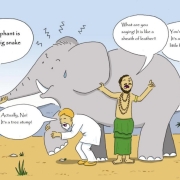
Then difference appears.
One person wants more closeness. The other wants more space.
One person wants to talk things through immediately. The other needs time to process.
One person feels hurt by what was said. The other feels accused and misunderstood.
One person thinks the money should be saved. The other thinks it should be enjoyed.
One person wants order. The other wants freedom.
One person remembers what happened one way. The other remembers it differently.
Suddenly, the beloved becomes “other.”
This is often the moment when the binary mind takes over. Instead of experiencing difference as something to understand, we experience it as something to defeat. We stop being curious and start building our case. We listen for what is wrong in the other person’s perspective. We gather evidence. We defend our innocence. We try to prove that our version of reality is the correct one.
Without intending to, we move from partnership into opposition.
The Survival Instinct Beneath Conflict
When we encounter difference in someone we love, it can feel far more threatening than we expect.
On the surface, we may be arguing about dishes, money, time, tone of voice, sex, children, plans, or who said what. Underneath, something much deeper is often happening. Our nervous system may interpret difference as danger.
If you see things differently than I do, will I still matter to you?
If you do not understand me, am I alone?
If you want something different, will I be abandoned, controlled, criticized, or dismissed?
If I yield, will I disappear?
If I do not win, will I lose myself?
This is why conflict can escalate so quickly. The subject matter may be ordinary, but the emotional meaning underneath it can feel enormous.
In a binary frame of mind, difference easily becomes a threat. If one of us is right, the other must be wrong. If one of us gets our way, the other must lose. If your feelings matter, mine may not. If I acknowledge your pain, I may have to surrender my own.
This is the great dilemma for those of us who dream of becoming one with a partner while living in a world that trains us to divide, compare, defend, and win.
In the consciousness of separation, love can feel like union only until difference appears.
The Moment Love Has to Grow Up
It is easy to feel loving when we agree.
It is easy to feel close when the other person reflects us back to ourselves in a way we enjoy.
It is easy to feel generous when our needs are being met, our feelings are being understood, and our point of view is being affirmed.
The real test of love comes when difference enters the room.
Can I stay connected to you when you do not see things my way?
Can I remain curious when I feel hurt?
Can I care about your experience without abandoning my own?
Can I make room for your truth without feeling that mine has been erased?
Can we stand on the same side of the problem instead of turning each other into the problem?
This is where love has to grow beyond romance and preference. This is where love becomes a practice of consciousness.
Moving from Consciousness 1.0 to Consciousness 2.0
I think of this shift as moving from Consciousness 1.0 to Consciousness 2.0.
Consciousness 1.0 is the consciousness of separation, comparison, and survival. It sees difference as a problem. It organizes around either/or thinking. It asks, “Who is right?” “Who is wrong?” “Who is winning?” “Who has the upper hand?” “How do I protect myself?”
Consciousness 2.0 begins to perceive from a wider field. It does not erase difference, but it does not worship it either. It begins to see that two people can have different experiences without one of them being the enemy. It makes room for complexity, compassion, mutuality, and shared responsibility.
In Consciousness 2.0, the question changes.
Instead of asking, “How do I win?” we begin asking, “How do we understand what is happening between us?”
Instead of asking, “How do I get you to admit I am right?” we begin asking, “What are you experiencing that I have not yet understood?”
Instead of asking, “How do I protect myself from your difference?” we begin asking, “How do I remain connected to myself and open to you at the same time?”
This is not a small shift. It is a profound reorientation.
It does not happen all at once. We do not simply wake up one morning and permanently leave behind our defensiveness, our fears, our need to be right, or our instinct to protect ourselves. Human beings do not evolve that way.
Instead, we begin to glimpse a wider way of seeing. We notice a moment when we could have attacked, but we paused. We notice a moment when we could have dismissed our partner’s feelings, but we listened. We notice a moment when we could have insisted on our version of the truth, but we made room for theirs.
Little by little, these glimpses become choices. The choices become practices. The practices become familiar. Eventually, what once felt unnatural begins to feel more like who we really are.
Love That Can Hold Difference
Love from the perspective of Consciousness 1.0 often depends on sameness. I feel close to you when you agree with me, want what I want, validate my experience, and do not challenge my view of reality.
Love from the perspective of Consciousness 2.0 is different. It can sustain a sense of union in the presence of difference.
This does not mean anything goes. It does not mean we surrender our needs, silence our truth, excuse harmful behavior, or pretend conflict does not matter. In fact, Consciousness 2.0 requires more honesty, not less.
But the honesty is held differently.
Instead of using our truth as a weapon, we offer it as a doorway into deeper understanding. Instead of using our partner’s difference as evidence against them, we become curious about the world they are living in. Instead of trying to defeat the other person’s point of view, we try to understand how it makes sense from inside their experience.
This is the beginning of real intimacy. It is not the intimacy of perfect agreement or emotional fusion. It is not the intimacy of one person disappearing into the preferences of the other.
Real intimacy is the capacity to remain lovingly present while two distinct human beings tell the truth about what they see, feel, need, fear, and hope for.
The Path Forward
When couples get stuck, they are often not lacking love. They are lacking a level of consciousness spacious enough to hold the love they already have.
They may still care deeply about each other, but their conflicts are being run through a binary operating system. The system keeps asking, “Who is right?” The relationship is quietly asking a deeper question: “Can we learn how to understand each other?”
This is where the path opens.
The next time you find yourself in conflict with someone you love, try noticing the frame of mind you are in.
Are you trying to win?
Are you building a case?
Are you listening only to defend yourself?
Are you making the other person’s difference mean that they do not love you, respect you, or care about you?
Then pause and ask a different question.
“What am I not understanding yet?”
This one question can soften the battlefield. It can interrupt the reflex to defend. It can create just enough space for love to reenter the conversation.
And if both people are willing, another question can follow.
“What would help this work better for both of us?”
That is the movement from win/lose to win/win.
That is the movement from opposition to partnership.
That is the movement from Consciousness 1.0 to Consciousness 2.0.
A Different Kind of Love
We are not here simply to fall in love with someone who reflects back what we already believe, prefer, and understand.
We are here to learn a deeper kind of love. It is a love that can stay awake in the presence of difference. It can listen without surrendering itself. This is the kind of love that can speak truth without domination by making room for two human beings, two histories, two nervous systems, two sets of needs, and two ways of seeing.
This kind of love is not automatic. It is not the default setting of the culture we live in. It has to be chosen, practiced, and cultivated.
But when we begin to live from this wider consciousness, something beautiful becomes possible. Difference no longer has to mean distance. Conflict no longer has to mean combat. Love no longer has to collapse when otherness appears.
Instead, our differences can become invitations to grow beyond the small self that needs to win and into the larger self that knows how to love.