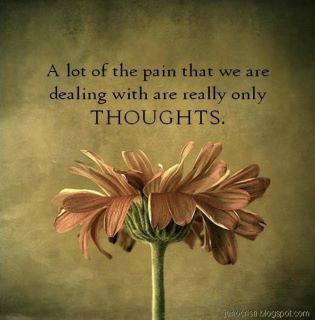

In the theater of one’s mind is a multi-dimensional consciousness in which our thoughts point our attention in a particular direction.  Neuroscientists have discovered that repetitive thoughts form neural pathways as neurons that fire together get wired together.  Thus, the more a particular thought or belief is activated and reinforced, the stronger these neural pathways become and the more automatically they become our “go to” pattern of perceiving.  Ever feel like you were in a rut or maybe a little insane for doing the same thing again and again and expecting different results?  Maybe there is something to be said for it being “all in your mind” – or at least to some significant degree.  The power of human thought is also worth considering in terms of the ongoing influence that society and family beliefs have in molding our point of view as individuals – for better and for worse.

Here’s some good news about this.  Neuroscientists use the term “neuroplasticity” to refer to the fact that our brains have the ability to change our synaptic wiring, which is reflected in our point of view.  Thus, we have the opportunity to intentionally change our thinking by forming new neural pathways that in turn will change our experiences.  Indeed, we have the opportunity to be powerful creators of our own consciousness or to be passive heirs to the autopilot programming of our own history and external authorities.

When we are operating unconsciously on autopilot, we are selectively perceiving our experiences by interpreting them in a way that is in alignment with our existing beliefs, fears, hopes, and dreams.  Quite literally, it’s almost impossible for a different point of view to get through to us when we are on autopilot.

Our expressions and behaviors are quite literally self-fulfilling prophesies of our mindset.  Over time, when we are running on autopilot, new experiences simply serve to validate our existing way of being in the world – our autopilot responses to future experiences.  Thus, when we are not consciously encountering our lives, our experiences simply validate and reinforce our existing beliefs and fail to inform us of new possibilities.

When our perceptions of ourselves, others, and the world we live in are based on little or no conscious awareness and intention to create greater health and well-being, our lives are defined by the autopilot recycling of our attitudes, judgments, illusions, delusions, memories and memory patterns, thoughts, feelings, fears, hopes, and dreams.  We exist in a veiled state unable to see what is right in front of us.

Autopilot is not all bad.  For example, when we establish healthy habits like eating right, exercising, getting enough sleep, and having a healthy sense of self, we can put them on autopilot and not think about them unless and until we have the need to change them.  However, autopilot can get us in trouble if we have negative patterns of thoughts or emotions running us and we aren’t even aware of it.  The degree to which we allow our negativity to run on autopilot (without conscious awareness) is the degree to which we are powerless over it.

In contrast to autopilot, when we create through conscious intention, we bring our awareness fresh and new to each present moment and allow our beliefs, fears, hopes, and dreams to change based on new input.  This updating process allows new and different thoughts and feelings to emerge, which in turn can result in new behaviors and ways of being and experiencing our lives.  We have the ability to consciously direct our thoughts and feelings through the power of intention, thus taking a far more active role in creating, promoting, and allowing more of what we want in our lives. The state of our consciousness forms the bedrock upon which the dramas of our lives unfold. Within the privacy of our own consciousness – in the theater of our mind – we create our own sense of reality, which we inhabit as our role in the great drama of life.  It is a complex structure, like a skeletal system for our consciousness.

An old Chinese proverb captures the power of our thinking in shaping our lives:

Sow a thought and reap an act;

Sow an act and reap a habit;

Sow a habit and reap a character;

Sow a character and reap a destiny.

This is true for us as individuals as well as for groups and societies at large.  Thoughts persisted in become taken for granted and are often misidentified as the truth because of their familiarity.  They become the building blocks and assumptions that serve as the foundation for a point of view that, unchallenged, will invisibly run on autopilot and shape our future thinking.

To step into the process of creating our lives through conscious intention, unencumbered by all of this is to simply be – free and authentic, with a sense of personal accountability and responsibility for our own creations. When our consciousness is present in the moment, we live in our authenticity, encountering and integrating our new experiences, open to change and alteration as appropriate.  There becomes a fluidity and aliveness to our experiences rather than a rote repetition of the past.  Even our deepest, most treasured beliefs no longer define who we are.  We let go of our story, as we awaken to the magnificence of living more consciously in each moment.  However, the price of admission is to let go of the need to be ‘right’ in a fixed point of view and to move fluidly through life, open to change and evolving one’s point of view.


Photo Credit: Creative Commons

Sometimes, seemingly out of left field, your partner becomes someone you don’t recognize. An invisible line gets crossed and you find yourself being treated like his or her enemy or someone they are disinterested in rather than as their cherished partner. One minute everything seems fine and the next you don’t recognize this person inhabiting your loved one’s body. What do you do? Is it a passing, but forgivable, mood? Or is something bigger going on here? Is it time to pack your bags? Time to stand up for yourself? Or is it time to work on your relationship together? The fact of the matter is there are no hard and fast rules here except to pay attention, hold your own counsel, and trust your gut.

Chances are when things get this out of hand it’s because neither of you have developed effective enough communication skills to be really heard by each other. When communications are running smoothly – even when you have very different points of view, and emotions and stakes are high – both parties are concerned not only for their own preferences, but for the health of the relationship and the well-being of their partner as well.

The bottom line is that a marriage or partnership can only be as healthy as the two people involved. Since there are no perfect people, there are no perfect relationships. Most of us have never learned how to have healthy disagreements and therefore end up either fighting for our own point of view or withdrawing from the conversation. This kind of fight or flight response carries with it two very dangerous consequences. First, it triggers a primitive physiological response where our blood flows to our extremities and quite literally renders us less brainpower with which to work. Secondly, it places us in an adversarial response mode where we view our partner and his or her different point of view as the enemy we are fighting against or fleeing from. When it gets to this point anything your partner says other than “you’re right” will be rejected and just add fuel to the fire.

As we move through our lives, our behavior in relationships is a powerful and accurate mirror and feedback mechanism for us to see ourselves in action. Unfortunately, when the going gets tough, too many of us project our own imbalances out onto our partner and end up lashing out by blaming and judging them or withdrawing our caring. The idea of bearing responsibility for our own part of the dysfunction by recognizing our own fears and unmet needs and going to work on them gets lost in the shuffle. If you come into the relationship with dysfunctions (which we all do), sooner or later they are going to be acted out. We are complex, multi-dimensional beings and from birth to death, whether or not we are in primary relationships with other people, we will always be in relationship with ourselves. What this means is we need to take responsibility for our own health and well-being physically, mentally, emotionally, and spiritually. When we do that, we have a far better chance of having healthy relationships with others.

Here’s an example. John and Mary have been together for a few years and both seem to really want their relationship to last. There are minor irritations and grievances here and there, but they always seem to work things out. Then Mary becomes increasingly stressed out about some other aspect of her life and her stress starts spilling over onto their relationship. She becomes short-tempered, judgmental, and emotionally unavailable to John. Then one day, she lashes out at John with an overblown reaction fueled by a litany of past, unresolved grievances she has been building resentment over. John is blind-sided. He doesn’t recognize himself as this awful person with whom Mary is so furious. Stunned in the moment, he doesn’t have a clue what to do. Clearly, there is no talking to Mary when she is worked up like this. So, he retreats and starts running all her accusations through his mind and starts to doubt himself, reasoning that she knows him better than anyone else, so maybe she’s right – maybe he is the terrible, selfish, inconsiderate loaf she is making him out to be. But, another voice in his head is probably saying “No, I’m not that person and I don’t recognize Mary when she acts like this and am wondering what I am doing with someone like this.”

So, what are their options. Unless either or both of them move past their myopic self concerns and consider the impact their discord is having on each other and the relationship there is probably little that can be done. They will either wear themselves out or wear their partner down and possibly kiss and make up until it happens again. Maybe one or the other will hit their limit and decide they are better off out of the relationship then in it and leave. Alternatively, they will get professional help to learn how to recognize their own dysfunctions in action and to resolve their differences in a healthy manner.

I do not believe that either the longevity of a relationship or a lack of disagreements is a sound indicator of its health. People stay in relationships for all kinds of good and bad reasons and many stay together far longer than is in either partner’s best interest.

Whether a couple is married or not, the choice to be a couple inherently suggests a level of commitment to care about the well-being of your partner and the health of the relationship. Each couple needs to carefully consider the nature of their relationship commitment. For example, in the traditional marriage vow are they pledging to be together until the death of one or the other’s body or the death of the relationship itself?

When in doubt, pay attention, hold your own counsel, trust your gut and see where that leads you. If you believe that you and your partner will be able to learn and use healthier communication skills – go for it. If not, cut your losses, learn your own lessons, and move on.

When was the last time you challenged your own beliefs? When I work with couples to design their wedding ceremonies, I always ask them how they were raised in terms of religion and spirituality and where they are now in those terms in their lives. I have always been in awe of the deep questions regarding human existence – What is the purpose of our lives? What about God? If you believe in the existence of God, then how do you live your life as a true reflection of that belief? In working with couples, I am sad to discover how few have truly probed questions like these. Many label themselves as affiliated with a particular religious tradition, yet do not actively participate in its practices.

So, who are you in these terms? And, what do you believe? Do you actually breathe life into your beliefs by living according to the precepts of your tradition? I was in the airport recently and saw a family eating their homemade sandwiches together. They didn’t dress like the rest of us. Their clothes were humble and homemade, the grown and young girls wore their hair in pigtails, the mother wore no makeup, they had no cellphones or electronic games – they simply had each other. They prayed together before eating and I witnessed a loving camaraderie of interconnectivity between them all. Each of our lives is strongly informed by the presence or absence of our parents’ religious or spiritual worldview. Some of us sustain these traditions for the rest of our lives with varying degrees of personal passion, while others rebel against them or find a different perspective that seems to suit us better.

Regarding belief or disbelief in God, Pascal’s Wager offers an interesting perspective. He knew that reason was not the basis upon which one could establish the existence or non-existence of God. However, he recognized that the act of believing or disbelieving had certain predictable outcomes. In the case of one who believes in God, there are two possibilities. If God does not exist, the believer has perhaps been comforted by his or her belief, but is eternally unaffected. In the event of God’s existence, according to Pascal, the believer will be blessed by what he called ‘eternal salvation’ or what I might call alignment with God’s will. For the non-believer there are also two possible outcomes as well. If God does not exist, the non-believer suffers no real consequences other than the smugness of being ‘right’ having taken an unpopular position. If God does exist, Pascal reasoned that the non-believer
would face eternal damnation. His conclusion? Given the options of facing either no consequences or hell as a non-believer or no consequences or heaven as a believer, Pascal reasoned that it makes sense to open oneself to faith.

So, if for no other reason than to hedge one’s eternal bets, those who have never really explored the deeper questions of life’s purpose and the existence or absence of God and what all that means, exploring this terrain appears to be a wise investment of time and attention.

I have explored these questions for most of my life and been richly comforted by the beliefs that have resonated most deeply within me. My personal beliefs are not relevant here, but the experience of finding my truth has been one of my most treasured experiences. I regularly challenge my beliefs and they guide and comfort me each and every day. I encourage you to take stock of your beliefs. Are they alive within you or passive, intellectual concepts? Do you extend the freedom of belief to others? Or do you find it necessary to try to convince them that they are wrong and you are right? I do not believe that one set of beliefs is suitable for us all. Rather, it seems to me that we are each evolving in our own ways and what makes sense from one person’s perspective may seem ridiculous or wrong to another. I think it is important to remember that different reference points yield different points of view and if you stood in another’s shoes, you would most likely see and believe as they do. Tolerance and respect for our differences is essential to shared peace in this world.

So, what do you believe? And, are you able to extend the freedom of belief to others by honoring your differences? If not, why not?

We all have sensitivities to the behaviors of others and it can be helpful to look below the surface of that dynamic. Our automatic response is generally to blame and judge the other person and then to attempt to get them to change their behavior. Why? Because we perceive their behavior to be the source of our irritation or upset. We want to decrease or eliminate our distress and the obvious solution seems to be to get them to stop doing what irritates us.

But wait – while this might be an effective short-term solution, it doesn’t deal with the fact that we have the hot button in the first place. Usually these sensitivities point to something much deeper in our psyche that has little to do with the situation at hand.

Here’s an example. I tend to get extremely irritated by the “customer service” and/or technical support telephone experience. I find myself talking back at the mechanical voice that tells me how important my call is to the company and I get increasingly irritated by the call routing process of “press 1 for this and 2 for that.” There never seems to be an option for what I am calling about and I just want to talk to a human being who cares about my concern and can help me. By the time I finally reach someone, I’m often so upset that I feel the need to tell them so before getting down to business which simply starts us off on the wrong foot. Granted, in my perfect world, customer service and technical support would be efficient and effective in responding to the customer’s needs in a timely fashion. But, in reality they seldom are. So, of what use is it for me to get upset? Why don’t I just take a deep breath when I need to call for help, accept the reality that it will take more time than I would like, and be grateful that someone will eventually help me? Can you even begin to imagine how hard I am on myself when I am inefficient or ineffective? Inside of me, there is this mini-kingdom of inner torment that generates great billowing clouds of negativity when I encounter inefficiency and ineffectiveness in myself and others. When someone honks on that button, guess what? It’s not their fault! It’s simply a reminder to me that I need to get to work desensitizing myself in that particular area.

So, what are your buttons? Ask yourself – are you a completely mellow-mannered person or do you have hot spots that spew anger when provoked? Does it happen when you are impatient? When someone cuts you off driving? When someone repeatedly interrupts or talks over you? When someone is unkind, inconsiderate, mean, petty, or small-minded? What sets you off?

Next time someone pushes your button, look inward instead of outward for the key to restoring your inner peace. Even if you can’t stop yourself from reacting in the moment, take the time after the fact to explore your inner territory. What assumptions are you making about how people or the world should be?

When I explored my issues with customer service experiences, I discovered that I really did believe that customer service systems and representatives should always be efficient and effective. So, the problem I experienced was not that they lacked these characteristics, but that I was unwilling to accept this reality. We live in a very imperfect world where human behavior is concerned. When we rage against the imperfections, we add more negativity to the mix. I am not suggesting that we simply play victim to the injustices and imperfections we experience with each other. Rather, we need to first and foremost be responsible and accountable for our own contribution – to our own reactions. If we are not inclined to raise public awareness about the issue at hand by proposing solutions and seeking momentum to bring about change, then our job is to tend our own garden. For my little drama this means reminding myself that the experience is likely to be more time-consuming than I would like and choosing to be as efficient and courteous as I can be to improve my chances of having a better experience. I also, put the phone on speaker and play computer solitaire while I wait – that helps a lot.

So, next time someone pushes your button, consider trying the following techniques to restore your inner peace:

• Count to ten before you react.

• If you must react, make sure your response is productive and does not add fuel to the fire.

• Choose to focus inwardly on your own consciousness rather than outwardly on the other person and their behavior.

• Ask yourself what beliefs or assumptions you hold that are in conflict with your experience and seek a more reality-based perspective.

• Remind yourself that you are an active participant/contributor to the quality of experience you are having.

• Seek to master skills in dealing with those parts of your experience that aren’t to your liking in a way that serves the highest good of all concerned.

Imagine how much nicer this world would be if we each did our part to desensitize our anger buttons!

Is there anything we take more for granted than life itself? We are alive – what a miracle! 

Here are some questions to think about:

  • Are you living your life on the surface checking off endless to-do lists?
  • When was the last time you had a deep conversation with someone you love or a total stranger?
  • How well do you really know yourself, your family, and friends?
  • From where do you draw meaning in your life?

When I was in college, I discovered The I Ching. I was particularly fascinated by how this ancient book of oriental wisdom captured the comings and goings of the rhythms of life. It  juxtaposed joy and sorrow, light and dark, life and death.

Each movement in the dance of life has embedded within it opportunities and challenges to awaken one’s consciousness.  Intuitive wisdom is woven into the human experience. Yet, how many of us are paying attention to these deep messages of the mysteries of life and death?

Our physical muscles require exercise for optimum performance. So too does the part of our consciousness that is capable of perceiving life’s deepest mysteries and lessons. There are many sensual and delightful pleasures to be enjoyed and disturbing experiences to be avoided living on life’s surface. However, there are also dimension of love, spiritual transcendence, compassion, and other rare gifts of life’s bounty. 

At a Death Café, I was struck by how vastly private and diverse our experiences and approaches are to life’s end. Seventy strangers showed up to talk about death with each other. What a testament to the hunger many of us have to share the richer and deeper parts of ourselves.

At my table of six, there was a woman with stage four metastatic breast cancer. She spoke of breaking the silence of the death taboo with her family. She invited them into a frank discussion about her prognosis and what that meant for them as a family. The rest of us were typical of the society as a whole, silenced on the topic yet hungry for existential meaning. Our conversation was energetic, profound, and respectful of differences. It was a refreshing opportunity to have others bear witness to our deepest truths and fears. I confess that I have a really strong aversion to the name “Death Café.” But once I got over that the experience itself was deeply enriching.

Our table was like a microcosm of the world at large. One person is living moment to moment with a terminal diagnosis. Another is a devout member of a local Bruderhof Christian community. Two had only a vague sense of what they believed. Another discounted any and all beliefs regarding death and/or what happens after death. For him, it was all purely speculation. I joined the conversation from the perspective of the author of Making Peace with Death and Dying. It was inspired by the profound lessons I learned having spent the final nine years of my mother’s life as her caregiver.  As diverse as our points of view were, there we all were with a shared desire to let total strangers into our private inner worlds. We bore witness to one another’s most passionately held and life affirming and altering beliefs.

Conversations like this with ourselves, our loved ones, or total strangers are important. They provide an opportunity for us to claim and affirm what resonates and reverberates as truth within us. This kind of sharing exercises those deeper consciousness muscles so that we can learn to express them more freely. Articulating our inner truth brings our relationships to a deeper level. It helps us to inform each other about the beliefs that guide us in making our daily and life altering decisions. As we share deeply with others, we broaden our horizons and bridge the gap of our otherwise very private inner worlds. Instead of giving each other an airbrushed version of ourselves, we risk the vulnerability of letting others know who we most profoundly know ourselves to be.

One of the things that is most precious to me is deeply connecting with another person in such a way that we experience a transcendence into the sacred territory of mutual respect and oneness. These moments of encounter are very few and far between despite the fact that I have a lot of like-minded friends. I can’t help but wonder why we spend so much of our time disconnected from each other.  

Here are some more questions to think about: 

  • How deeply do you know yourself?
  • How deeply do you let your family and friends know you?
  • How precious are you making the gift of your life?
  • Are you living as though your humanity, mortality, and divinity really matter? If yes, how? If not, why not and what might you be willing to do differently?
  • How do you imagine our shared world could be different if we really lived as though our humanity, mortality, and divinity really mattered?


If you would like to know more about me and my work, please explore my website here.

Do you know someone who might benefit from reading this article?
If so, please share it with them. 

Many of us hold in our hearts the desire for, or perhaps even the memory of, a Thanksgiving gathering joyfully sharing a feast of plenty with family and friends where everyone is happy like in the Norman Rockwell Thanksgiving image entitled, “Freedom from Want.” Unfortunately, reality often fails to measure up to this ideal. Some of us find ourselves dreading a family holiday gathering where we anticipate being miserably caught in a reenactment of the dysfunctions of our childhood family gatherings. Others, yearning to be with familiar faces and traditions, find themselves adrift far from home either alone or as a guest, perhaps feelings like an outsider, at someone else’s table with unfamiliar traditions.

If you anticipate a Thanksgiving that will fall short of your desires, you are sure to have that experience. This is especially true if your imaginings are focused on the menu and who will or will not be there. If, on the other hand, you focus on the spirit of thanksgiving, which is about being grateful then your focus turns inward to where you have a choice about how you experience whatever your holiday circumstances might be.

What I am suggesting here isn’t a Pollyanna approach, but rather a radical form of gratitude that just might give you a whole new and delightful experience as a powerful creator of your own experience and not the victim of circumstances or the behaviors of others. Be patient. This is a process not a one time fix it solution.

Here’s an example. Let’s say you are spending Thanksgiving with your family and dreading all their questions and judgments about what you are doing with your life because you know your truth will never garner their approval. How have you handled this in the past? Perhaps by creating your best spin on what’s going on with you in advance, or maybe by drinking too much, or physically and/or emotionally isolating yourself, or getting angry, or some other creative attempt to protect yourself from having to feel the pain of their disapproval. What if, instead of dreading their disapproval, you welcomed it as an opportunity to heal the part of you that somehow buys into their disapproval? Think of it as a tug of war that you have the power to dissolve by releasing the tension on your end of the rope.

The key to this approach is to change your own point of view on the situation. Instead of thinking they are wrong and you are being picked on, consider the possibility that this experience is absolutely perfect for you to learn some importantly needed lesson in your life. Wouldn’t it be great to be able to let them have their disapproval of you while being emotionally free of their opinions? How sweet would that be!

What I am proposing here is not easy, but it works. Here are 6 keys to how you can use radical transformational gratitude to be at the cause rather than at the effect of your own experience in any situation.

1. Accept the situation as it is without trying to change it. Imagine that you are establishing a brand new neural pattern in your brain (which you are) so that you can view the situation in an entirely new way, which in turn will give you a different way of experiencing it. So, before gathering with your family, pay attention to your self-talk. Play a game with yourself to identify all the ways that you experience your resistance and dread.

2. Listen to your self-talk and pay attention to your feelings. Notice your expectations (thoughts, and feelings) that are based on the belief that it’s going to be the same old awful experience as in the past.

3. Make a list of all the ways you identify in Step 2. For each one, create a forgiveness statement such as the three following examples:
• I forgive myself for judging myself as the black sheep of the family.
• I forgive myself for judging myself for hating my father for being so critical of me.
• I forgive myself for judging myself for judging my family for rejecting me.
Be as specific as possible in capturing the nature of the disconnect between you and your family. Notice that what you are forgiving is any judgment that you have been creating towards yourself or others. Keep this list handy during your family visit and run these forgiveness statements through your brain whenever you get caught in the old pattern.

4. Play detective with yourself to identify your emotional hook. Ask yourself some of the following questions and create and probe some of your own questions until you find a deeply resonant ‘aha’ within you indicating that you have identified your deeper truth in this situation:
• What’s my emotional payoff in the way I have been experiencing this situation?
• What is the nature of my pain and suffering in this situation?
• What do I really want to be true here and what might I do to create, promote, and allow more of what I want without making others wrong?
With each answer you get, go deeper by asking ‘what’s underneath that?’

5. Close your eyes and do the following gratitude process. One by one, call forward each person you have held responsible for your unhappiness – including yourself. Breathe deeply into your heart and imagine that you are intentionally sending love from your heart to this other person. Looking into their eyes, say ‘My happiness is not dependent upon your approval. I love you. God bless you. Peace, be still.’

6. Assume that this situation is for you and not against you and be grateful that it has presented you with the opportunity to deepen your friendship with yourself.

Notice that the unpleasant situation that you were facing was not something ‘bad’ but rather a perfect opportunity and steppingstone for you to improve your mental and emotional health and wellbeing. Now that’s something to be grateful for!

Happy holidays, everyone.

If you are one of those people who dreads the holidays or simply does not want to experience a repeat performance of holidays past, this article is for you.  Preparing for the holidays is not just about eating food, buying presents, and making travel arrangements.  The kind of holiday season you will have is not primarily determined by who you are with, how they behave, and what presents you receive.  

The #1 key to enjoying the holidays is choosing to be an active, conscious participant and not a passive, unconscious victim.

What you do in your inner mental and emotional kingdom will determine whether you suffer through yet another holiday or do your best to ensure that you optimize your chances to have a delightful time.  Blaming and judging others for your dissatisfaction keeps you stuck in your unhappiness.  If you want to create, promote, and allow yourself to sing a different tune this year, you have to get in the driver’s seat to make that happen.

Empower yourself, not others, to determine the quality of your experience.

I remember shopping in Filene’s Basement in Boston once and the memory still makes me giggle while also reminding me of one of life’s most powerful lessons.  A woman asked her friend what she would tell her husband about all the things she was buying.  The friend replied, “I’m just going to tell him the devil made me do it.”  Well, just where was that devil and how is it that he or she had the power to take over that woman’s personal authority and responsibility for her own actions?  Too many of us play victim over the holidays disclaiming responsibility for our actions and experiences.  We tell ourselves we have no will power to resist all the treats and temptations.  We feel sorry for ourselves when we don’t feel loved and cared for by those with whom we share the festivities, or we feel left out because we have no invitations to be anywhere we really want to be.  Often, we think we are the only one in that situation.  When we are with our family, we often revert to the dysfunctional roles we played with each other during our childhood.  Many of us get depressed because this holiday season shows no promise of being wonderful.

What to do?  Here’s a plan to renovate your holiday experience:

Step One: Set a Clear Intention to Give Yourself a Good Holiday Experience:  Don’t commit to trying to do it differently.  Commit to doing it differently.  Make your own needs and happiness important to yourself and commit to doing your very best to take care of yourself.

Step Two: Assess Your Options and Set Realistic Expectations:  If you have been stuck in a rut of feeling obligated to spend your holidays with people you don’t enjoy being with, then your options will be far different from those of someone whose loved one has just died.  Survey your situation.  First ask yourself, “what do I really expect is going to happen this holiday season?”  Be ruthlessly honest with yourself because your expectations are the foundation upon which your experience will be built.  They are self-fulfilling prophecies of what is to come.  It’s kind of insidious, but what we believe to be true has power.  Beliefs function like a screening mechanism whereby we prove ourselves to be right.  If you tell yourself that unpleasant circumstances, situations, and events will repeat themselves, they will – because that’s the only option you believe is available to you.   Alternatively, you can anticipate the challenges and temptations you will encounter, and choose to create a happier holiday as a gift to yourself.

From where you stand right now, what are you anticipating your holiday season to bring your way?  What about it looks good to you and what looks dreadful?  Have you experienced those dreadful things in the past?  How well did you handle them? With 20/20 hindsight and ruthless honesty, do you see anything you might do differently that could yield a better experience for you?  Were you on autopilot reacting to your experiences or were you really staying present in the moment trying different strategies to improve your experience?  If you can’t think of any alternative ways of experiencing the same old challenges, imagine someone you consider to be savvy and outstanding at handling these kinds of situations.  What would he or she do?  Are you willing to step outside your comfort zone and try something new or would you rather just suffer through it all again?

If you are particularly tender-hearted due to the death of a loved one or some other sensitive new experience in your life, be honest with yourself about what you really need.   Maybe everyone else’s well-intended concern for your well-being is more than you can bear right now.  Maybe you’d just like to be alone and let the holidays pass uneventfully.  It’s OK.

Let the filter through which you assess your options be about your true needs rather than any concern for what others might think.  Have the courage to trust your own instincts rather than trying to please others by following tradition or doing what you think they expect.

Step Thee:  Get Creative and Bold: Be proactive.  Here are some of the things you might do differently:

Find a new place to belong.  Think of someone with whom you’d really like to spend the holiday.  Let them know why it would be meaningful to you and ask if it’s possible.  If not, think of someone else.  If you end up with yourself that need not be a lonely option.

Spend the holidays in service to others.  Whose holiday might you make brighter?  Is there an organization in your area that you would like to help?  Is there someone you know who could use your loving kindness?

Consider a feast for one.  Some of my favorite Thanksgiving Day memories are from creating and eating an entire feast for one and having fabulous leftovers for days.

Let the holiday pass uneventfully.  If there is no one available you would really love to be with and don’t want to be bothered with holiday activities, honor that as the right choice and not a “poor me” scenario.

Host your own holiday.  Rather than being someone else’s guest, take the initiative to be the architect of a holiday with you as the host(ess).

Give yourself a lavish holiday for one.  Maybe that means travelling to somewhere exotic or decorating your home over the top and buying yourself lots of presents that you wrap rivaling Martha Stewart’s finest work.

Be with the same people, but do it very differently.  Sometimes, drastic measures are called for.  If you have a family member or fellow participant who treats you as though you are emitting a really bad odor, practice not letting his or her negativity in.  This may take a lot of effort and time to perfect.  Consider new strategies like praying for you both, distracting yourself into being helpful to your host(ess), having meaningful exchanges with others, and minimizing the opportunities for this person’s behavior to infect your experience.  It all helps.  And, you may find it all too tiresome to continue being in this person’s company and decide to go in another direction entirely.

Trust your intuition about what is right for you no matter how different from what other people think you should do.  If you find yourself not experiencing a strong sense of belonging anywhere but with yourself or feel more like an observer of other people’s festivities rather than a real participant, break free of obligations.  Be grateful for being invited, but maybe it’s time to strike out on your own.

The bottom line is to give yourself the holiday experience that is just right for you.  Do what is meaningful to you and be with people who appreciate you.  Some might view this as self-indulgent, but I see it as taking responsibility for warming the cockles of your own sweet heart.  Happy holidays everyone!


Please share your thoughts by leaving a comment below.

If you would like to suggest a topic for a future blog or ask me to address a particular situation or issue, please email me at judithjohnson@hvc.rr.com

To view a more extensive archive of my articles, visit me on the Huffington Post at: http://www.huffingtonpost.com/judith-johnson


(Image courtesy of Lindsay Mumma on http://www.trianglecrc.com/blog/holiday-stress/)

Divorce and what leads up to it are not tidy and polite affairs.  The children who bear witness to the demise of their parents’ marriage inevitably get wounded – some very deeply and invisibly at first.   No matter how old a child is when his/her parents’ divorce occurs, the child learns a life lesson about the shadow side of love and its potential impermanence.  Learning this lesson through the end of your parents’ marriage and perhaps the subsequent re-partnering of either or both parents, is confusing at best and life-threatening for young children who are dependent upon their parents for their very survival.

When we fall in love and marry, many of us have stars in our eyes and fantasize about living happily ever after.  Then reality sets in and tests our ability to fulfill our vows to love, honor and cherish each other through the trials and triumphs of life.  If we lived in a perfect world, love would last and be stronger than all the challenges that tear us apart.   In reality, maintaining a loving relationship takes a lot of commitment, honesty, and vulnerability.  It’s not for the faint of heart.

As a child of divorce, a life coach, and an interfaith minister who officiates at many weddings, I do not think that divorce, in and of itself, is a bad thing.  In fact, I wish my own parents had divorced much earlier than they did which would have spared us from living in a cold war of mixed messages at home that wore a public mask of a perfect family.

When a parent leaves, so does a part of the child – we often hide the vulnerable and innocent parts of ourself to avoid dealing with our feelings and needs.  We lack the personal resources to cope and our parents are too busy fighting, so most of us are left with the options of either expressing or repressing our emotions and fears.  Hiding them is usually a safer bet.

These days most parents are too busy to be as attentive as their child(ren) need them to be when the family is falling apart and the kids are too often left to fend for themselves.  However, this is a crucial time for a child.  No matter how young or grown a child of divorce is, he or she has probably internalized some deep lessons that may remain as an unconscious filter through which he or she experience the rest of their life unless and until becoming aware of those messages and developing a realistic and healthy understanding of  the matter.  The two most dominant messages that kids of divorce internalize are believing that their parents’ divorce is somehow their fault and that love is conditional and might not last.  Let’s take a closer look at both of these messages.

Younger children tend to be more susceptible to thinking the divorce is their fault.  “If only I hadn’t … then Mommy and Daddy would still be together” is what many kids tell themselves.  Some try to “fix” the situation by being on good behavior, imagining that doing so will be all that is needed to bring the parents back together so they can live happily ever after as a family.  Even after the parents are officially divorced and are living separately, many children fantasize about what they can do to get their family back together again. For a child who thinks his or her bad behavior is responsible for the parents splitting up, it makes sense that they think their good behavior might reunite them and that their bad behavior might stave off a new suitor.

The second dark message many children of divorce hear is that love is conditional and does not last.   ‘You loved my Mommy or Daddy, then he/she did something you didn’t like and now you are divorced.  I better be careful or you’ll divorce me too.” We want our children to believe that our love for them is unconditional, but divorcing their other parent gives them a mixed message.

When we internalize the message that love doesn’t last, we learn to protect ourselves from getting hurt by not getting too close to anyone.  We may evolve a survival strategy of avoiding intimacy – especially emotional intimacy as a way to avoid the vulnerability of ever feeling so powerless and devastated again.  We may keep to ourselves or choose to use other people without actually bonding with them.

What can parents do to help their children thrive rather than hide when the family is breaking apart?

• First, don’t assume that reassuring your child that you love him/her is enough.

• Know that no matter how careful you might have been not to fight in front of the children, they saw and heard and felt their family falling apart and had no personal resources to do anything about it.

• Know that no matter whether they act out or put a smile on their face, their world is falling apart too.

• Take lots of time with them to help them draw out their deeper feelings and needs. Talk to them. Listen deeply. Use forms of creative expression to draw out their deeper truth. Go for counseling together. Reach out to their teachers and guidance counselors to help you watch for signs of distress. Check out books and websites on the topic.

• Keep the lines of communication with each child strong and open on a daily basis and keep a loving connection with them throughout their adulthood. Make a commitment with your X to both do this for each child and to not interfere with each other doing so.

• If the child acts out, make sure that your reaction communicates that your love is not conditional based on their behavior – i.e. “I love you and will always love you, but I will not accept that behavior.”

• Never complain to the child about the other parent.

• Never let them see or hear your judgment of the other parent. For the sake of the children, please play nice with your X when coordinating care and decisions regarding the children.

These days most parents are too busy to be as attentive as their child(ren) need them to be when the family is falling apart and the kids are too often left to fend for themselves.  The health and well-being of your children is your responsibility until they are able to take care of themselves.  Pay attention and be sure they feel your love no matter what.

Trust is an interesting concept — and far more exciting as an action. Trusting yourself involves the willingness and confidence to rely on your own integrity, abilities, and character to meet the challenges of a particular experience, or all of life for that matter. For me, trust is not only a psychological factor, but has a spiritual component as well because God is very much a part of my worldview.

I believe that the ultimate gamble with the greatest potential gain in life is to trust yourself and that in so doing, you gain a level of freedom, authenticity, and peace that is unreachable any other way. Trust requires living in your own skin, recognizing your own authority as the very best arbiter of what is for you and what is not. We may have learned as children to trust and rely upon the authority of others to tell us what to do and when to do it. But there is a profound and authentic inner voice that lies dormant within us all until we start to listen to it and recognize its ability to express our deepest truth and to guide us with the most precise discernment of what will serve our highest good — whether we like it or not. Some call this their “inner” or “true” self, and some suggest this is the spark of the divine that resides in each of us. Either way, just as with physical exercise we are trained to strengthen our core muscles, we must strengthen this core self as well by exercising its voice. That’s how we learn to trust ourselves. Otherwise, we remain at the effect of external sources of authority and simply react to them, usually with the intention of getting their approval or affecting their perception of us in some way.

In my second doctoral dissertation, I focused on the topic of trust because I had become profoundly aware of the fact that whenever I felt out of balance, the bottom line was that I wasn’t trusting myself. As I explored the internal wiring of my consciousness, I discovered something remarkable — my lack of self-trust was so fundamental to my way of being that I was living my life built upon the intention of avoiding pain and suffering. I knew that it was fairly normal to minimize our distress, but my behavior was an all-encompassing way of being whereby I sought to anticipate and avoid perceived sources of suffering.

There was an ironic and fundamental flaw in my approach. In my effort to achieve greater happiness by avoiding pain and suffering, I was actually attracting them to me by focusing upon them rather than on the happiness I sought. I was equating happiness with an absence of pain. In fact, our minds act like great magnets attracting to us what we focus upon, which in turn makes our intentions and focal points self-fulfilling prophecies.

Inherent in my approach was the fact that I neither trusted myself nor God, and so I played God by attempting to write the script of my life. I recognized this as the most pivotal shift I needed to make in my consciousness to improve my physical, mental, emotional, and spiritual well-being, and I wanted the joy, ease, grace, and abundance that it would bring forth in my life.

So, what about you?

Do you trust yourself?

Do you tend to live at the effect of people and events outside yourself?

Or, alternatively, do you experience yourself as capable of living your life with all its unanticipated twists and turns?

Here are three keys that really helped me make this wonderful transformation of my inner experience. First, I practiced keeping my consciousness focused in the present moment until that became a good habit. This replaced my previous habit of worrying so much about the future. It empowered me to take appropriate action in the only time frame that affords us that opportunity — the present.

Secondly, I observed myself and developed a list of my physical, mental, emotional, and spiritual experiences and expressions during the presence or absence of trust in my consciousness. Creating this list helped me to recognize what it looks like and feels like to be trusting — to put flesh on the bones of the concept of trust. For example, I noticed that when I was experiencing trust, I was physically relaxed, comfortable, open, with fluid and graceful movements. In contrast, when lacking trust, I became rigid, tense, stressed, and pushed others away. Mentally, I was not feeling attached to my point of view, worrying, judging others, or avoiding anything. Instead, I was paying attention to what was present and cooperating with it. Emotionally, trust allowed me to go with the flow, confident that I could meet whatever came my way. This was an enormous contrast to my previous experience of anger, fear, agitation, resistance to whatever I did not like, and doubting my ability to be happy in life. Spiritually, trust brought an attunement to the highest good of all concerned and the desire to surrender to “God’s way” rather than demanding “my way.” Rather than playing God, I learned to recognize God’s wisdom and presence in my life.

Finally, I practiced, practiced, and practiced doing more of the things that brought greater trust, and breaking the habit of doing those that did not. I came to believe that there is nothing “wrong” that I have to try to fix. I discovered that trusting is about letting go of “should”s, “have to”s, demands, expectations, fears, illusions, and delusions. The more I surrendered into trust, the more it became my automatic response. Rather than closing down and retreating in response to pain and suffering, I built skills in experiencing them and learning from them. This built my openness and trust that God’s infinite wisdom is present at all times — not just in the experiences that I like.

There is not a woman in this country who has been immune to the experience of finding herself falling short of the commercial, albeit airbrushed, ideal of female beauty that bombards us every day. Comparing ourselves to this unreal standard of beauty gives us a sense of being unworthy, a failure, unable to measure up. Many women live with an insidious undercurrent of self-loathing as a result. Many dread seeing a picture of themselves or trying on a bathing suit or undressing before a new lover. Women are encouraged to live with a belief that we are not, and will never be, beautiful unless we “fix” our “imperfections” through diet, exercise, surgery, or Spanx.

Isis Charise, a photographer in Kingston, NY and the founder of The Grace Project, is doing her part to change all that. She has a way of photographing women of all shapes, sizes, ages, and ethnicities that provides a doorway for them to access a connection within themselves through which they are able to recognize themselves as beautiful women. Isis facilitates their process of taking ownership of and embodying a deeper, perennial, and more authentic kind of beauty.

In the Grace Project, Isis is bringing her transformational photography to women who have had mastectomies — giving them permission to see themselves as beautiful and whole. She offers her subjects two very powerful metaphors that allow them to see themselves through new eyes. Referencing the Venice de Milo, Isis reminds the women she photographs that this sculpture became even more beautiful after losing its arms to the trauma of history. The other metaphor she shares is the Japanese art of kintsugi, meaning “golden joinery” whereby the cracks of a broken bowl are filled with gold dust and adhesive. Symbolically, the point is not to try to restore something to “as good as new” but rather to incorporate the brokenness into enhanced beauty that is “better than new.” Isis’ subjects are liberated from society’s standard of beauty and are able to see the brokenness of their bodies in a way that has given them a greater power, peacefulness, and beauty.

A recent exhibit of the Grace Project images at the Greene County Council for the Arts demonstrated that these images are also transformational for the viewer. One of the gallery employees shared the story of a burly man who walked into the gallery and was brought to tears by these images. His mother had recently had a double mastectomy and he had never seen what it had done to her body. Several weeks later, his mother ended up in hospital and he was called upon to care for her and dress her. He came back into the gallery to thank them because had he not seen Isis’ images he would never have been prepared to help his mother in such an intimate and nurturing way.

Another man viewing these images said that at first he didn’t even notice that these women’s breasts were scarred or missing. He was captivated by the power of each woman’s presence and initially just saw beautiful pictures of beautiful women.

One of Isis’ subjects is a 58-year old woman currently living with Stage 4 metastatic Breast Cancer. She spoke of her experience facing a bilateral mastectomy. “I had no idea what my body would look like after surgery or what would happen to my body. Someone told me about Isis’s work and I looked at these images of women who looked at peace with their bodies whether they had reconstructed or not. It opened up for me the option of not having reconstructive surgery. I could choose to save my life doing this. I could picture that I would be a whole person afterwards.” On one level, she now views her cancer as a gift saying “somehow through this journey I have reconnected to the part of myself that is the most melike when I was ten or eleven or in my 20s. I have arrived in a powerful place through this journey and the choice to forego reconstruction.”

Another woman wrote to Isis referencing the fact that during her photo shoot she had been referring to her Frankenboob. Seeing her photographs, she had come to realize that her breast sacrificed itself so she could have however many years she has left, and vowed to never use that derogatory term again.

Barbara Sarah is a 21-year Breast Cancer survivor who acknowledged we have come a long way from back in the day when “a breast was only something on a chicken or turkey or robin. It was not a word that we used. Now “breast” has become part of the vocabulary and visually what Isis is doing is dealing with the taboo about looking and witnessing.” Barbara, like many Breast Cancer survivors, has devoted herself to serve others. Nineteen years ago, she founded what is now known as the Oncology Support Program of HealthAlliance of the Hudson Valley in New York. The philosophical underpinnings of this group are rooted in Japanese Buddhist psychology focused on being grounded in living in the now, paying attention, being grateful, and living fully in the moment. “I thought that would be a great philosophy for working with cancer patients,” Barbara said. “It’s not just talking about cancer, it’s about how do you live a life with meaning and purpose?”

I am not a woman dealing with Breast Cancer. However, my relationship with my body has been profoundly uplifted by seeing these images. I hope they will give you a better appreciation for how important it is that a woman’s sense of wholeness and beauty come from within her and not be diminished by false external standards.

The images of the Grace Project have the potential to be the new and healthy faces we put on Breast Cancer. Please visit and “like” the Grace website and Facebook.

The Grace Project: Breast Cancer Portraits

View Slideshow Gallery

The project is a not-for-profit 501c3 under the “Artspire” program of the New York Foundation for the Arts.

  • To learn more about Grace Crowd funding campaign before December 31st click here.


I invite your generosity.

Current Grace Project initiatives that need your support include:

  • Photographing a total of 120 racially and geographically diverse women of all ages who have had mastectomies (25 have been photographed to date). There are many women around the country waiting to be photographed and, unfortunately, the clock is ticking for many of them.
  • Producing two books. One is a collector’s edition of fine art prints. The other is envisioned to be a mass-produced and freely distributed version for which corporate sponsorship is being sought so these images can serve newly diagnosed women as an alternative visual reference to the scary and clinical images they are currently being shown. These images belong in breast cancer resource centers, hospitals, oncology support centers, and the offices of plastic surgeons.
  • Creating a traveling exhibition and pop up gallery throughout the country that can be part of local Breast Cancer awareness events, fund raising walks, foundation galas, or exhibitions at galleries, museums, hospitals, and oncology centers. Isis would like the exhibit to provide a forum for women to talk to each other about Breast Cancer options, issues, and individual choices.


Please feel free to contact Isis directly at isisimages@yahoo.com if:

  • you have ideas, connections or comments you would like to share.
  • you are a gallery, museum, or Cancer Support organization interested in scheduling an exhibition.
  • you are a philanthropic, or corporate entity interested in providing funding.
  • you have been moved by these images and would like to share your experience with Isis.


Please spread the word and help these images and the Grace Project go viral. What a wonderful gift to us all this holiday season — especially these brave women who have shared their images.
Please share your thoughts by leaving a comment below.

If you would like to know more about me, please visit my website at http://www.judithjohnson.com

If you would like to suggest a topic for a future blog or ask me to address a particular situation or issue, please email me at judithjohnson@hvc.rr.com

To view my Huffington Post archive click here: http://www.huffingtonpost.com/judith-johnson


Note: All images in the slide show and video have been provided by Isis Charise who has received a signed model release from all of the women appearing in the photographs.