

It’s very easy to fall into a “poor me, nobody loves me, I’m going to go eat worms” state of mind when you don’t have any invitations for the holidays. Alternatively, you could choose to enjoy your holidays anyway. It’s all in how you see it and who you hold accountable for the situation. Here are some strategies that might help you sort your situation out and maybe, just maybe, have your best holiday season yet.

  1. Avoid the blame game: It is so easy and automatic for most people to look at being alone for the holidays as wrong, unacceptable, and a prescription for unhappiness, but it doesn’t need to be that way. Being alone — whether because of a family feud, no one thinking to invite you, or the death of a loved one with whom you would have shared the holiday — can be a blessing in disguise. So, be open to the possibility that this could be a good thing and nobody’s “fault.” Blaming yourself or others for being alone only makes matters worse and wastes a lot of your precious energy in negative thoughts and feelings. So save the energy you would otherwise have expended on blaming and judging yourself and others and put it to better use. This may be an entirely new experience for you, but that doesn’t mean it has to be unpleasant.
  2. Accept the situation as it is: You don’t have to like the idea of being alone, but accepting it frees you to take action that can lead to a happy holiday. Acceptance might not come easily, but make it a goal to move past any hurt feelings or sadness you have about being alone with the intention of accepting what is so. (For more information and understanding about the power of acceptance, see my post “Acceptance: The First Law of Spirit.”)
  3. If you are grieving a profound loss, be patient and tender with yourself: If you are grieving over the holidays, it may be that taking advantage of the time and emotional space to be with your grief without a pep squad of well-intentioned people trying to make you feel better could be just what you need. My first four Christmases after my mother’s death, I was at very loose ends. My Christmases were full of traditions and expressions of caring that we shared. I always extravagantly decorated the house and tree, baked too many cookies, and overdid it with presents and fabulous wrappings. Without her, all those activities seemed meaningless to me. The fifth year, I was finally ready to turn to myself rather than to others to define what kind of Christmas would make me happy. I invited friends to help decorate my tree, bought and wrapped presents for myself, had my favorite Christmas morning breakfast, giggled as I opened my presents, and cooked myself an entire turkey dinner. I had so much fun I’m going to do most of that again this year.
  4. Decide to create a happy holiday for yourself: Granted, “happy” is a relative term. For some it might simply mean not feeling like an outsider at someone else’s version of the holidays, while others will want to reach out and find new people who would like to share the festivities. Think of it as “my holiday, my way.” If what you have done in the past is not an option, then do some soul-searching and consider what would be most meaningful to you. For some, giving to others serves as a reminder of our interconnectivity and the importance of looking beyond our own situation. Offering acts of service to others who are less fortunate always benefits the giver as well as the recipient.
  5. Count your blessings: Here is a starter list of some of the good news about spending a holiday alone. Please feel free to share your additional ideas in the comment section at the end of this article to inspire others with new ideas.
    • A free day or weekend that you weren’t expecting to have. You can sleep late, be lazy if you wish, clean out a closet, go to the movies, read a great book, or just follow the path of serendipity.
    • Spending less money on gifts and special outfits for the occasion
    • Having more control over how much you eat and drink
    • The opportunity to create your very own holiday feast with your favorites, not someone else’s — and you get to keep all the leftovers
    • The opportunity to create your own holiday gathering, to take a trip, or to get to know yourself a little better

Regardless of what activities you engage in over the holidays, be sure to take the time to
connect in your heart to the spirit of the holidays. For example, on Thanksgiving, whether with a crowd or by yourself, dive into the wellspring of gratitude for all you do have in your life and allow yourself to sense the oneness with others who will be acknowledging their blessings as well. My wish for you is that you treasure yourself and take the very best care of yourself possible… and have some fun!

If you would like to know more about me and my work, please explore my website here.

Also, if you know anyone who might get value from this article please email or retweet it or share it on Facebook.

Choose to take the Light road, the Light option,
to relate to whatever is going on in a Light way so
you can enjoy yourself and have fun while you go
through it.

You can laugh or you can cry.
You can enjoy yourself or you can suffer.

Happiness is always your choice.

John Morton

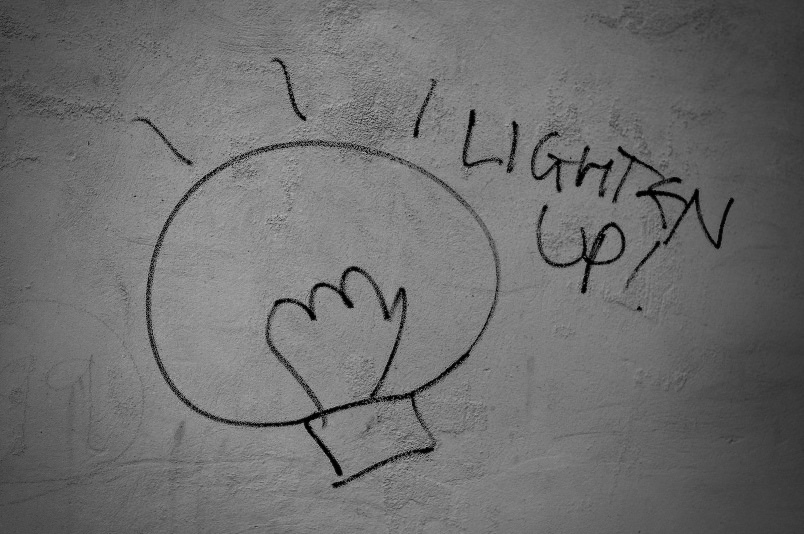
Lightening up your life is about choosing to transform your trials and tribulations into revelations and intentionally engaging in the journey of uplifting your consciousness. Light is not only one of my favorite topics but something we all need to understand better if we want to sit in the driver’s seat of our own lives.

On the physical level of our existence, light exists as a reflection. What we see is the electromagnetic radiation of wavelengths. This illumination or giving off of light is what allows us to see one another and the world around us. In order to be seen or to see in the physical world, we move out of darkness into light.

In the non-physical or spiritual realms, light is a state of being or awareness. Some speak of the “I am” presence — the awareness of one’s true self or identity being spiritual in nature rather than the physical identification of one’s self as a body with a personality. Physically, you reflect light. Spiritually, you are light. Put the two together and you become quite magnificent!

There is a bridge between the light of the physical and spiritual worlds. This bridge is your consciousness — what you think, what you believe, where you focus your attention or awareness and thereupon take action. Unless and until you decide to shed light on this process, your default settings carry on diligently — most often without your awareness. Aristotle uses the metaphor of light to exemplify how an active intellect works — the one who makes choices, takes actions (both physical and non-physical), the one who turns on the light, so to speak.

I had a dream once where my mother and I were in a huge domed room filled with windows of all shapes and sizes — each with its own customized window shade. Some of the shades were fully drawn while others were partially or completely rolled up exposing the light. My mother asked, “What should we do?” to which I replied, “Open as many as we can to get as much light shining in here as possible.”

Years later, life has taught me that each of us has a different tolerance and desire for light — both physically and spiritually. I don’t say that as a judgment, but rather as an observation of our individualized path of personal evolution. Notice how much light you are willing to shed on your life’s journey.

Some people are so busy reciting their woes and experiencing themselves as victims of the circumstances and people in their lives that it never occurs to them that they have the power to change how they perceive their situation. This is another classic example of “Is your cup half empty or half full?” Are you so busy keeping track of every disappointment or irritation in your life that you are missing the opportunity of being grateful for what is going well at the same time? If you are one who sees the potential for more light in your life, consider some of the following wisdom and techniques for gaining more altitude so you can see more clearly what is really going on.

Next time you are in a foul mood, try this simple technique:

  1. Notice that the irritation is alive inside of you.
  2. Choose to believe that you have the power to lighten your load by looking at your situation differently.
  3. Imagine that you are climbing into a hot air balloon and rising above yourself and your situation.
  4. Keep shifting your focus away from your initial point of view and practice noticing the circumstances and experiences of others involved in the situation with you or those of others who are less fortunate.
  5. Keep doing this until you can conjure up some compassion, acceptance or understanding for others or find yourself shifting your focus to what you have to be grateful for in your life.

If that doesn’t improve how you feel, try asking yourself the following questions:

  • What could I do differently so I wouldn’t be so upset?
  • How else might I look at this situation?
  • How much of my discomfort is due to my habitual way of reacting to things I don’t like?

Each of us chooses the quality of our lives through the choices me make and those we avoid. If your life isn’t bringing you happiness, satisfaction, learning and growth then maybe it’s time to take a better look at how you are creating, promoting and allowing what is present in your life. Shine some light on your repetitive thoughts and feelings and you are sure to find some clues of what you could be doing differently to yield better results.

If you would like to know more about me and my work, please explore my website here.

Also, if you know anyone who might get value from this article please email or retweet it or share it on Facebook.

I was raised Catholic by a Catholic mother and a Lutheran father and lived in a community where I had a lot of Jewish friends. That was my world view as far as religion was concerned: Catholic, Protestant and Jewish until my mother gave me a book one Christmas — about the world’s great religions — that opened my mind up to a world beyond my immediate circumstances.

I was taught that one of the motivations for being “good” was that when you died, you would go either to Heaven, Hell or Purgatory. Those who went to Heaven would be with God, those in Hell spend eternity with the Devil and the in-between cases, who needed some more purification before going to Heaven, would go to Purgatory. My mind as a child accepted the logic of that as abstract as it was.

It was Limbo that bothered me because those who were not baptized in a Christian faith were considered to have not had the stain of original sin removed from their souls and would therefore spend eternity in Limbo with no chance of ascending to Heaven. I remember being deeply bothered by this because it meant that none of my Jewish friends or their families could ever, ever be with God. That made me very sad, and while I never told them so, I felt very sorry for them. I imagined Limbo to be somewhere up in the clouds and filled with hammocks that inhabitants occupied for eternity — which certainly seemed better than Hell, but hopeless.

This was the only teaching I ever had on the subject of what happens to us when we die until my 30s when Buddhist teachings about life and death started showing up in bookstores. Instinctively, I resonated with the concept of reincarnation and our essential identity as souls. I began to develop an eclectic spirituality as I awakened a sense of the truth that lived within me. In the process, I stopped practicing Catholicism and found a different path of spiritual nurturance.

I confess to being outraged when I read a tiny news item in 2007 claiming that the Roman Catholic Church eliminated the concept of Limbo because it “reflected an unduly restrictive view of salvation.” What? What about all those souls hanging out in hammocks for all these centuries? What happened to them? Was there a relocation program? Or were they never there in the first place? How do you erase a concept that you have preached as truth to millions of people without so much as an apology for messing with our worldview all these years? Why was this taught in the first place? What other parts of the Catholic Church’s interpretive doctrine or that of other religious organizations should people be careful about blindly accepting? It’s not as with science where a newly discovered fact negates a previous theory about the world we live in.

For me, this raises a critically important issue for all believers of all religious and spiritual traditions. On the one hand, I think that leaders of any religious/spiritual tradition should hold themselves accountable for clearly distinguishing between fact and leaps of faith. There should be a warning label or blanket disclaimer that simply states, “this is what we believe to be true.” I think personal discernment should be encouraged rather than shunned as indicating a lack of faith. On the other hand, I believe that ultimately each of us must wrestle with our own inner awakening of what we believe to be truth — not because someone else told us so, but because we have taken it upon ourselves to find and embrace a deeper sense of meaning regarding matters of God and the meaning of life and death. It’s easy to unconsciously and blindly follow teachings presented by others — especially when we are children and our parents — our Gods — tell us what is true. But eventually, it is our personal responsibility to take over authority for what we choose to follow as truth. In the realms of religion and spirituality, many of us are innocent babes in the wood. We deserve to be guided with the utmost care.

If you would like to know more about me and my work, please explore my website here.

Also, if you know anyone who might get value from this article please email or retweet it or share it on Facebook.